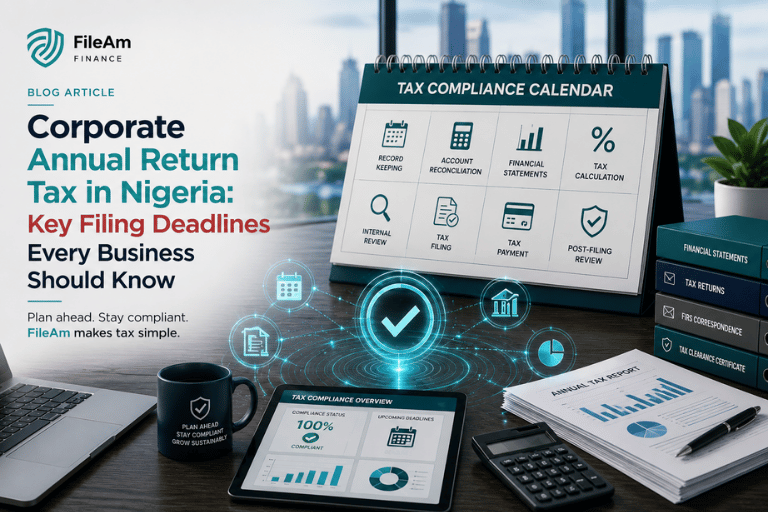
Managing taxes is one of the most important responsibilities of running a registered business in Nigeria. Yet, many companies miss filing deadlines not because the tax laws are difficult to understand, but because they fail to organize their compliance activities throughout the year. Instead of viewing tax obligations as isolated events, successful businesses treat them as part of an annual compliance cycle that begins immediately after the close of each financial year.
Understanding corporate annual return tax in Nigeria is essential for every company, whether you operate a startup, a growing small or medium-sized enterprise (SME), or a large corporation. Timely tax compliance helps businesses avoid penalties, maintain a good relationship with regulatory authorities, and improve their credibility with investors, banks, and government agencies.
Unlike some regulatory obligations that follow fixed calendar dates, corporate tax filing in Nigeria is based on a company’s financial year-end. This means every business has its own compliance timetable, making it even more important to understand the date for corporate tax returns in Nigeria that applies to your organization. Businesses that prepare early can complete their filings with minimal stress, while those that wait until the last minute often face unnecessary pressure, errors, and the penalty for late payment of corporation tax in Nigeria.
A structured compliance calendar transforms tax filing from a yearly emergency into a predictable business process. Instead of scrambling to gather receipts, reconcile accounts, or prepare financial statements a few weeks before filing, businesses can spread these activities across the year, ensuring greater accuracy and efficiency.
In this guide, you’ll learn how the corporate tax filing cycle works in Nigeria, the key milestones every business should monitor, common compliance mistakes to avoid, and practical strategies for building an effective annual tax compliance calendar that keeps your business on track year after year. This article builds on the principle that tax compliance is most successful when it is approached as a continuous process rather than a one-time event.
What Is a Corporate Tax Compliance Calendar in Nigeria?
A corporate tax compliance calendar is a structured schedule that outlines every major tax-related obligation a company must complete during its financial year. Rather than reacting to approaching deadlines, businesses use this calendar as a planning tool to organize financial activities, prepare statutory documents, and meet regulatory requirements on time.
Many business owners mistakenly believe that tax compliance simply means filing an annual tax return. In reality, effective compliance begins long before the filing deadline. It involves maintaining accurate accounting records, monitoring business transactions, reconciling financial statements, preparing supporting documentation, and ensuring that all tax obligations are completed within the required timeframe.
For businesses managing corporate annual return tax in Nigeria, a compliance calendar serves several important purposes:
- It establishes clear deadlines for every stage of the tax filing process.
- It reduces the likelihood of missed filings and associated penalties.
- It improves the quality and accuracy of financial reporting.
- It enables management to allocate sufficient time and resources for tax preparation.
- It minimizes last-minute pressure on accountants, auditors, and finance teams.
A compliance calendar is not a document submitted to the Nigeria Revenue Service (NRS), formerly the Federal Inland Revenue Service (FIRS). Instead, it is an internal management system that helps businesses coordinate their accounting and tax responsibilities throughout the year. Companies that consistently follow a structured compliance calendar are generally better prepared for annual tax filing, external audits, and other statutory reporting obligations.
One of the greatest advantages of maintaining a compliance calendar is that it shifts the focus from reactive to proactive tax management. Rather than rushing to locate missing invoices or reconcile months of outstanding transactions just before filing, businesses can complete these activities regularly. This approach not only improves operational efficiency but also strengthens internal financial controls.
For organizations with multiple branches, high transaction volumes, or complex financial structures, a compliance calendar becomes even more valuable. It helps coordinate different departments, ensures that financial information is collected consistently, and provides management with better visibility into upcoming compliance obligations.
Another important benefit is improved cash flow planning. Corporate tax liabilities can represent a significant financial commitment, particularly for growing businesses. By tracking compliance activities throughout the year, management can estimate potential tax obligations early and make adequate financial provisions instead of facing unexpected payment demands at the filing stage.
Businesses that integrate tax planning into their routine operations also tend to produce more reliable financial reports. Continuous documentation reduces errors, minimizes duplicate records, and simplifies the preparation of audited financial statements, which form an essential part of annual corporate tax returns.
Ultimately, a corporate tax compliance calendar transforms compliance from a stressful annual exercise into a routine business process. Instead of seeing tax filing as a once-a-year obligation, businesses develop a culture of continuous financial discipline that supports long-term growth and regulatory compliance.
Understanding Corporate Annual Return Tax in Nigeria
One area that often confuses business owners is the meaning of corporate annual return tax in Nigeria. Many people mistakenly assume that annual returns filed with the Corporate Affairs Commission (CAC) and annual corporate tax returns submitted to the Federal Inland Revenue Service (FIRS) are the same requirement. Although both are annual statutory obligations, they serve entirely different purposes and are administered by different government agencies.
Corporate annual return tax in Nigeria refers to the annual filing of a company’s corporate income tax return with the Federal Inland Revenue Service. This filing enables the tax authority to assess whether a company has accurately calculated its taxable profits and fulfilled its corporate income tax obligations in accordance with the Companies Income Tax Act (CITA).
A typical corporate tax return includes several important documents, such as:
- Audited financial statements.
- Tax computation schedules.
- Self-assessment forms.
- Capital allowance computations.
- Supporting schedules for taxable income.
- Evidence of applicable tax payments.
- Other statutory documents required by FIRS.
These documents collectively provide a complete picture of a company’s financial performance during the accounting year and form the basis upon which corporate income tax is assessed.
Unlike monthly tax obligations such as Value Added Tax (VAT), corporate income tax is generally assessed annually based on the company’s accounting period. Consequently, businesses should ensure that financial records are maintained consistently throughout the year rather than attempting to reconstruct financial information shortly before the filing deadline.
Understanding this distinction is critical because failure to comply with annual corporate tax filing requirements may expose a company to penalties, interest on outstanding tax liabilities, and delays in obtaining important compliance documents such as Tax Clearance Certificates.
Businesses that establish sound bookkeeping practices and integrate tax planning into their routine financial management generally experience fewer compliance challenges than organizations that treat tax filing as an isolated annual event. A structured approach improves accuracy, reduces compliance costs, and enables management to make informed financial decisions throughout the year.
For this reason, every registered company should understand not only its tax obligations but also how those obligations fit into an organized annual compliance calendar that supports sustainable business growth.
Overview of Corporate Tax Filing Structure in Nigeria
To understand how the annual compliance calendar works, it is important to first understand the overall structure of corporate tax filing in Nigeria. Every registered company is expected to comply with the provisions of the Companies Income Tax Act (CITA), which governs the assessment, filing, and payment of corporate income tax.
One of the most important principles businesses should understand is that corporate tax compliance does not revolve around a single national filing date. Instead, each company follows a filing schedule that is determined by its own financial year-end. This means that two companies operating in the same industry may have completely different filing deadlines if they close their financial years at different times.
For example, if Company A’s accounting year ends on 31 December, its corporate tax filing timeline will differ from that of Company B, whose financial year ends on 30 June. This flexible structure allows businesses to prepare tax returns based on their own accounting cycle while ensuring compliance within the legally prescribed filing window.
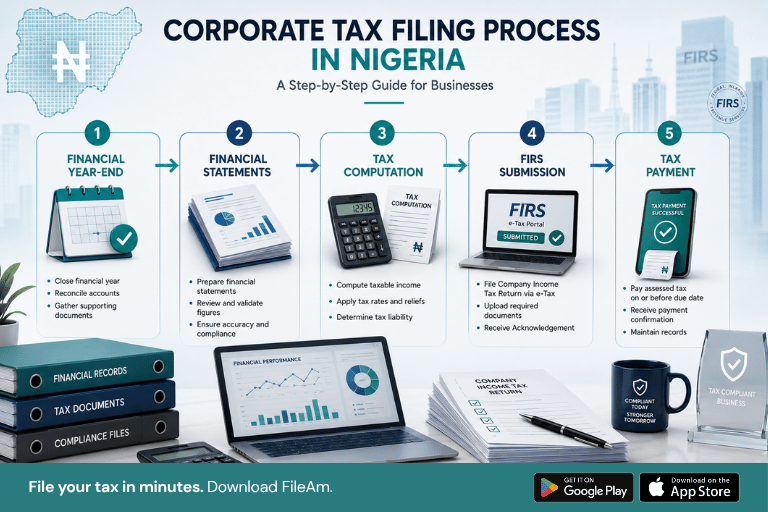
The process of filing corporate annual return tax in Nigeria is therefore built around four key stages:
1. Financial Year-End
Everything begins with the company’s accounting year-end. This date marks the conclusion of the financial reporting period and serves as the starting point for preparing annual corporate tax returns.
Once the financial year closes, businesses begin compiling financial information for the completed accounting period. The quality of records maintained throughout the year will largely determine how smoothly the remaining compliance process proceeds.
This is why companies that practice continuous bookkeeping generally experience fewer filing difficulties than businesses that postpone recordkeeping until the end of the year.
2. Preparation of Financial Statements
Following the financial year-end, businesses prepare their annual financial statements. These statements summarize the company’s financial performance and position during the completed accounting period.
This stage typically involves:
- Reviewing accounting records
- Reconciling bank accounts
- Recording outstanding transactions
- Verifying income and expenditure
- Adjusting accounting entries where necessary
- Preparing supporting schedules
Accurate financial statements are the foundation of every successful tax filing. Errors identified at this stage can usually be corrected before they affect tax computations, reducing the likelihood of disputes or amendments later.
Businesses that use reliable accounting software and maintain organized documentation throughout the year often complete this stage much faster than organizations relying on manual recordkeeping.
3. Tax Computation and Return Preparation
Once the financial statements have been finalized, attention shifts to tax computation.
Although financial statements present accounting profit, tax authorities require businesses to calculate taxable profit in accordance with applicable tax laws. This means certain accounting entries may require adjustments before determining the final corporate income tax liability.
During this phase, businesses typically:
- Calculate taxable profit
- Apply allowable deductions where applicable
- Prepare capital allowance schedules
- Complete tax computation worksheets
- Prepare self-assessment returns
- Assemble supporting documentation
This is often the most technical stage of the compliance process and requires careful attention to detail. Any omission or computational error may delay assessment or result in additional tax liabilities.
Companies that begin tax computation early are generally better positioned to review calculations thoroughly and resolve discrepancies before submission.
4. Filing and Tax Assessment
After completing the necessary documentation, the business submits its annual corporate tax return to the Federal Inland Revenue Service (FIRS) within the applicable filing window.
The filing package generally consists of:
- Audited financial statements
- Tax computation
- Self-assessment forms
- Supporting schedules
- Other statutory documents required by FIRS
Following submission, FIRS reviews the return and processes the company’s tax assessment based on the information provided.
If additional clarification or supporting documentation is required, the business may be contacted to provide further information before the assessment is finalized.
Prompt responses during this stage help avoid unnecessary processing delays.
5. Payment of Assessed Tax
Once the tax assessment has been finalized, companies are expected to settle any tax liability within the applicable payment period.
Timely payment is an important component of overall compliance. Businesses that delay payment may become subject to the penalty for late payment of corporation tax in Nigeria, in addition to interest that may accrue on outstanding liabilities.
Beyond the immediate financial consequences, delayed payment can also affect a company’s compliance status and its ability to obtain a Tax Clearance Certificate, which is often required for government contracts, banking transactions, investment opportunities, and other corporate engagements.
Maintaining adequate financial provisions throughout the year allows businesses to meet their tax obligations without placing unnecessary strain on cash flow.
How the Date for Corporate Tax Returns Nigeria Is Determined
One of the most common questions business owners ask is:
“What is the date for corporate tax returns Nigeria?”
The answer depends entirely on the company’s accounting year.
Unlike VAT, which generally follows monthly filing cycles, corporate income tax operates on an annual reporting cycle tied directly to the company’s financial year-end.
In practical terms, companies are generally expected to file their corporate income tax returns within the statutory filing period following the end of their accounting year. As a result, there is no single nationwide filing date that applies to every registered business.
The table below illustrates how different financial year-end dates influence corporate filing timelines.
| Company’s Financial Year Ends | Typical Corporate Tax Filing Window |
| 31 December | Up to six months after year-end |
| 31 March | Up to six months after year-end |
| 30 June | Up to six months after year-end |
| 30 September | Up to six months after year-end |
This flexible structure highlights why businesses should monitor their own financial reporting cycle rather than relying solely on public reminders about tax deadlines.
For finance teams, maintaining a customized compliance calendar is one of the simplest ways to ensure that critical dates are not overlooked. By recording the financial year-end, internal reporting milestones, audit schedules, and statutory filing deadlines in advance, businesses can distribute compliance activities evenly throughout the year instead of compressing them into the final few weeks before submission.
Ultimately, understanding the date for corporate tax returns Nigeria is not just about knowing when to file, it is about recognizing that tax compliance is a continuous process that begins long before the filing deadline arrives.
Annual Compliance Calendar for Businesses in Nigeria (Core Timeline)
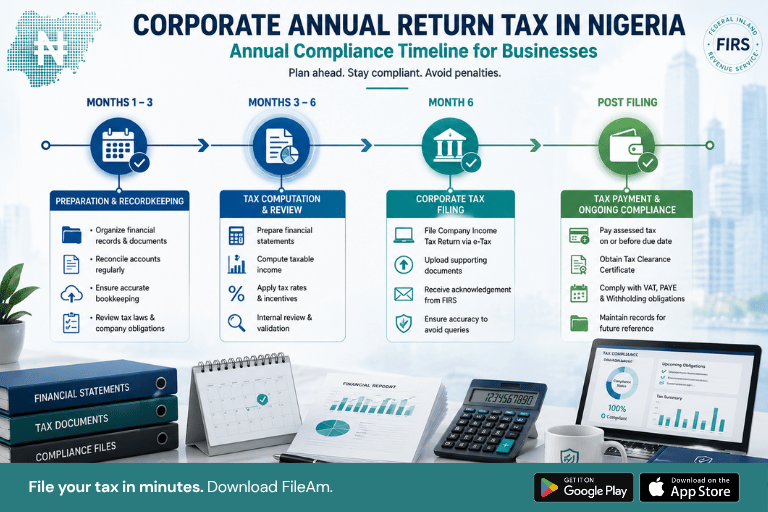
One of the biggest advantages of understanding corporate annual return tax in Nigeria is that it allows businesses to plan compliance activities well before statutory deadlines arrive. Rather than waiting until the filing period, successful organizations distribute tax-related responsibilities across the months following their financial year-end.
This structured approach minimizes errors, improves financial reporting, and significantly reduces the risk of non-compliance. Below is a practical breakdown of the annual corporate tax compliance cycle that most businesses can adapt to their own accounting year.
Months 1–3 After Financial Year-End: Preparation Phase
The first three months after the close of the financial year are dedicated to organizing the financial information that will support the company’s annual corporate tax return. This is arguably the most important stage of the compliance cycle because every subsequent activity depends on the quality of preparation completed during this period.
Businesses should use this time to ensure that all financial records accurately reflect the transactions of the completed accounting year. Waiting until the filing deadline to begin these activities often leads to missing documents, accounting errors, and unnecessary pressure on finance teams.
During this preparation phase, businesses typically:
- Finalize annual financial statements.
- Reconcile bank accounts and cash balances.
- Verify income and revenue records.
- Review operating expenses and supporting documentation.
- Organize invoices, receipts, and payment vouchers.
- Identify outstanding receivables and liabilities.
- Prepare schedules for fixed assets and depreciation.
- Confirm payroll records and statutory deductions.
- Resolve discrepancies identified during internal reviews.
This period also provides management with an opportunity to evaluate the overall quality of the company’s financial records. Any inconsistencies discovered at this stage can usually be corrected before they affect tax computations or audit processes.
For businesses that engage external auditors, beginning preparation early ensures that auditors have sufficient time to review financial statements without delaying subsequent tax filings.
Another important objective during this phase is document organization. Supporting records should be properly categorized and stored because they may be required to substantiate figures reported in the company’s tax return.
Businesses that invest time in careful preparation generally experience a smoother tax filing process and reduce the likelihood of future queries from tax authorities.
Months 3–6 After Financial Year-End: Tax Computation Phase
Once financial statements have been completed and verified, the focus shifts from accounting to taxation.
During this stage, businesses prepare the documents required for corporate annual return tax in Nigeria, calculate taxable profits, and assemble the information that will eventually be submitted to the Federal Inland Revenue Service (FIRS).
Although financial statements provide an accurate picture of business performance, accounting profit is not always the same as taxable profit. Certain adjustments may be required under applicable tax legislation before arriving at the company’s final tax liability.
Typical activities during this phase include:
- Computing taxable income.
- Preparing capital allowance schedules.
- Reviewing allowable and non-allowable expenses.
- Completing self-assessment computations.
- Preparing supporting tax schedules.
- Reviewing applicable tax incentives where relevant.
- Verifying previous tax credits or overpayments.
- Ensuring consistency between accounting records and tax computations.
This stage requires close collaboration between finance personnel, accountants, auditors, and tax advisers. Every figure reported should be supported by adequate documentation and consistent with the company’s audited financial statements.
Businesses that delay tax computation until the final weeks before filing frequently encounter avoidable challenges such as incomplete records, unresolved accounting issues, or rushed calculations that increase the risk of errors.
Beginning tax computation early provides sufficient time for management review and quality assurance before submission.
Month 6: Corporate Tax Filing Deadline
The sixth month after the end of the company’s financial year represents the most critical stage in the annual compliance calendar. It is during this period that businesses are expected to submit their corporate income tax returns together with all required supporting documentation.
Understanding the date for corporate tax returns Nigeria is essential because the filing deadline is linked to each company’s accounting year rather than a single nationwide calendar date. Businesses should therefore calculate their filing timeline immediately after the close of every financial year and communicate these deadlines internally.
Before submission, companies should confirm that all required documentation has been completed and reviewed.
A comprehensive filing package generally includes:
- Audited financial statements.
- Corporate income tax computation.
- Self-assessment forms.
- Capital allowance schedules.
- Supporting schedules for taxable income.
- Evidence of applicable tax payments.
- Other statutory documents required by FIRS.
Submitting complete and accurate documentation reduces processing delays and demonstrates a strong commitment to regulatory compliance.
Businesses should avoid treating the filing deadline as the beginning of tax preparation. Instead, filing should simply represent the final step in a compliance process that has been progressing steadily over several months.
Post-Filing Period: Payment and Compliance Confirmation
Corporate tax compliance does not end immediately after returns have been submitted. Following filing, businesses enter the post-compliance phase, during which tax assessments are finalized, outstanding liabilities are settled, and statutory records are updated.
During this stage, companies should:
- Review acknowledgements received after filing.
- Monitor the progress of tax assessments.
- Respond promptly to requests for clarification or additional documentation.
- Settle assessed tax liabilities within the prescribed period.
- Obtain and securely store compliance records.
- Maintain copies of filed returns for future reference.
- Update internal compliance registers.
Prompt payment of assessed tax is particularly important because delayed payment may attract the penalty for late payment of corporation tax in Nigeria, together with any applicable interest on outstanding liabilities.
Maintaining complete records after filing also benefits businesses during future audits, regulatory inspections, financing applications, mergers, acquisitions, and government procurement processes.
Rather than viewing tax compliance as a once-a-year obligation, organizations should treat post-filing activities as the starting point for the next compliance cycle. Lessons learned during one filing season can be used to improve recordkeeping, strengthen internal controls, and simplify future reporting obligations.
Monthly Compliance Habits Every Business Should Maintain
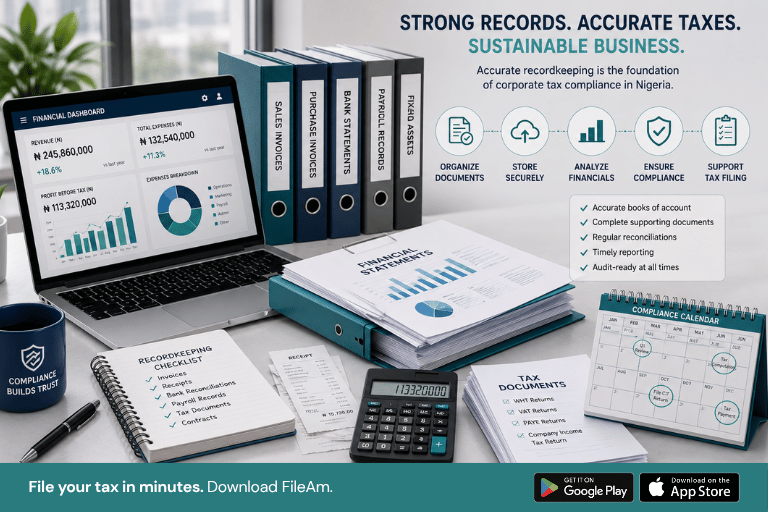
While annual filing attracts the most attention, successful tax compliance is built on consistent monthly financial discipline. Companies that maintain organized records throughout the year rarely experience the stress associated with last-minute tax preparation.
Developing good compliance habits also improves decision-making by providing management with timely and accurate financial information.
The following practices should become part of every business’s monthly routine.
Track Income Consistently
Every source of business income should be recorded promptly and accurately. Maintaining complete revenue records reduces reconciliation issues and ensures that annual financial statements reflect the true financial position of the company.
Document Expenses as They Occur
Invoices, receipts, supplier payments, utility bills, payroll records, and other expenditure documents should be retained immediately after each transaction. Waiting until year-end often results in missing documentation that may complicate tax computations.
Reconcile Financial Records Monthly
Monthly reconciliation of bank statements, accounting ledgers, and cash records helps identify discrepancies early. Small errors corrected promptly are far easier to resolve than issues discovered during annual reporting.
Align VAT Records with Corporate Accounting
Although Value Added Tax (VAT) follows a different filing schedule, VAT records should remain consistent with the company’s accounting system. Maintaining alignment between monthly VAT reporting and annual corporate tax records improves overall reporting accuracy and reduces inconsistencies during tax reviews.
Review Compliance Deadlines Regularly
Management should periodically review the company’s compliance calendar to ensure that upcoming milestones remain on schedule. Assigning responsibility for each stage of the compliance process helps prevent important deadlines from being overlooked.
By embedding these habits into everyday financial management, businesses transform tax compliance from a reactive obligation into a routine administrative process. Instead of scrambling to meet deadlines, companies are able to approach corporate annual return tax in Nigeria with confidence, knowing that accurate records, organized documentation, and timely preparation are already in place.
Key Corporate Tax Deadlines Businesses Must Always Track
One of the most effective ways to avoid missed filings is to understand that corporate tax compliance involves several important milestones, not just the final filing deadline. Businesses that monitor these milestones throughout the year are better prepared to meet their statutory obligations and maintain uninterrupted compliance.
Below are the key dates every company should include in its internal tax compliance calendar.
Financial Year-End
The financial year-end is the foundation of your entire compliance cycle. It marks the close of the accounting period and signals the beginning of the annual tax preparation process.
Immediately after the financial year closes, businesses should begin reviewing their financial records, reconciling accounts, and preparing for the annual audit. Delaying these activities only compresses the time available for accurate tax computation and filing.
Since the date for corporate tax returns Nigeria is tied to the financial year-end, every company should ensure this date is clearly documented and communicated to its finance and management teams.
Annual Audit Period
For companies required to prepare audited financial statements, the audit should be scheduled well before the tax filing deadline.
An early audit provides sufficient time to:
- identify accounting discrepancies;
- correct financial reporting errors;
- prepare tax computations accurately; and
- avoid delays in submitting annual corporate tax returns.
Businesses that postpone their audit often struggle to complete the remaining compliance stages within the statutory filing window.
Corporate Tax Return Filing Window
The corporate tax filing window begins immediately after the financial year ends and extends through the statutory filing period prescribed by law.
During this period, companies should ensure that all required documentation, including audited financial statements, tax computations, and supporting schedules, is complete before submission.
Treating this period as the final stage of an ongoing compliance process rather than the beginning of tax preparation significantly reduces filing risks.
Tax Assessment and Payment Timeline
Following the submission of corporate tax returns, businesses should monitor the progress of their tax assessments and settle any outstanding liabilities promptly.
Failure to pay assessed taxes on time may expose companies to the penalty for late payment of corporation tax in Nigeria, together with any applicable interest and administrative consequences.
Maintaining adequate cash flow provisions throughout the year enables businesses to meet these obligations without disrupting daily operations.
Annual Compliance Review
After completing the filing process, businesses should conduct an internal compliance review.
This review should evaluate:
- whether filing deadlines were met;
- areas where delays occurred;
- improvements needed in financial recordkeeping;
- opportunities to automate accounting processes; and
- changes required for the next compliance cycle.
Organizations that continuously improve their compliance systems generally experience lower compliance costs and fewer regulatory challenges over time.
How Different Business Types Fit into the Compliance Calendar
Although the corporate tax filing framework applies broadly to registered companies in Nigeria, the way businesses manage compliance often depends on their size, operational complexity, and financial structure.
Understanding these differences allows organizations to adopt compliance practices that are appropriate for their specific circumstances.
Small and Medium-Sized Enterprises (SMEs)
SMEs frequently operate with lean finance teams and limited accounting resources. As a result, bookkeeping responsibilities may be shared among business owners, administrators, or external accountants.
Common challenges include:
- inconsistent recordkeeping;
- delayed bank reconciliations;
- incomplete expense documentation; and
- limited knowledge of statutory filing requirements.
For SMEs, maintaining a simple monthly compliance calendar and using cloud-based accounting software can significantly improve tax readiness throughout the year.
Limited Liability Companies
Limited liability companies generally have more formal reporting obligations and are expected to maintain comprehensive accounting records.
These businesses should establish clear internal procedures for:
- monthly financial reporting;
- document management;
- internal approvals;
- audit preparation; and
- tax compliance monitoring.
Because they often engage with financial institutions, investors, and government agencies, maintaining continuous compliance is essential for preserving business credibility.
Foreign-Owned Companies Operating in Nigeria
Foreign-owned businesses face the additional challenge of coordinating local tax obligations with international reporting requirements.
Finance teams must ensure that:
- local accounting records comply with Nigerian regulations;
- reporting timelines align with group reporting schedules; and
- corporate tax filings satisfy FIRS requirements while supporting global financial reporting obligations.
Strong coordination between local and international finance teams helps reduce reporting inconsistencies.
High-Transaction Businesses
Organizations operating in sectors such as retail, manufacturing, telecommunications, logistics, or e-commerce typically process thousands of transactions every month.
For these businesses, manual recordkeeping can quickly become inefficient.
Automated accounting systems, regular reconciliations, and periodic internal audits are essential to maintaining accurate financial records and supporting timely corporate annual return tax compliance in Nigeria.
Common Mistakes Businesses Make with Corporate Tax Compliance
Many compliance challenges arise not because businesses intentionally disregard tax obligations, but because they fail to establish effective financial management systems.
Recognizing these common mistakes can help companies strengthen their compliance processes and reduce unnecessary risks.
Ignoring Financial Year Tracking
Many businesses know their incorporation date but fail to monitor the end of their accounting year.
Since the corporate filing timeline begins immediately after the financial year closes, losing track of this date often results in rushed preparation and missed deadlines.
Waiting Until the Filing Deadline
One of the most common compliance mistakes is postponing tax preparation until the final weeks before filing.
This approach often leads to:
- incomplete documentation;
- accounting errors;
- delayed audits;
- increased professional fees; and
- avoidable compliance pressure.
Successful businesses distribute tax-related activities across the year instead of concentrating everything into a short filing period.
Poor Financial Recordkeeping
Missing invoices, incomplete expense records, and inconsistent bookkeeping remain major causes of filing delays.
Maintaining organized financial documentation throughout the year simplifies tax computation and improves reporting accuracy.
Confusing Different Tax Obligations
Some business owners mistakenly assume that monthly VAT filing satisfies all corporate tax obligations.
In reality, VAT compliance and annual corporate income tax compliance are separate statutory requirements, each with its own filing procedures and timelines.
Understanding this distinction helps businesses avoid unintended non-compliance.
Failing to Plan for Tax Payments
Preparing accurate tax returns is only one aspect of compliance.
Businesses should also anticipate potential tax liabilities and make adequate financial provisions throughout the year.
Failure to budget for tax payments may result in cash flow difficulties and expose companies to the penalty for late payment of corporation tax in Nigeria.
Final Thoughts
Corporate tax compliance is not a one-time administrative task—it is an ongoing business process that begins with sound financial management and ends with timely filing and payment of statutory obligations. Businesses that understand corporate annual return tax in Nigeria and integrate compliance into their everyday operations are better positioned to avoid costly mistakes, maintain good standing with regulatory authorities, and support long-term business growth.
Rather than relying on reminders when filing deadlines approach, organizations should develop a structured annual compliance calendar that aligns with their financial year-end, accounting processes, and internal reporting systems. Regular bookkeeping, timely reconciliations, early audit preparation, and proactive tax planning all contribute to a smoother compliance experience.
Most importantly, every company should understand its own date for corporate tax returns in Nigeria, maintain accurate financial records throughout the year, and ensure that tax liabilities are settled promptly to avoid the penalty for late payment of corporation tax in Nigeria.
Tax compliance should not be viewed merely as a legal obligation; it is a reflection of sound corporate governance and responsible financial management. By adopting a proactive approach and following a well-planned compliance calendar, businesses can reduce administrative stress, strengthen stakeholder confidence, and focus on what matters most: sustainable growth and long-term success.
Frequently Asked Questions (FAQs)
What is corporate annual return tax in Nigeria?
Corporate annual return tax in Nigeria refers to the annual filing of a company’s corporate income tax return with the Federal Inland Revenue Service (FIRS). The return typically includes audited financial statements, tax computations, self-assessment forms, and other supporting documents required to determine the company’s corporate income tax liability.
What is the date for corporate tax returns in Nigeria?
The date for corporate tax returns Nigeria is generally determined by the company’s financial year-end. Companies are expected to submit their annual corporate income tax returns within the statutory filing period following the close of their accounting year. Businesses should therefore maintain an internal compliance calendar based on their own reporting cycle.
What is the penalty for late payment of corporation tax in Nigeria?
The penalty for late payment of corporation tax in Nigeria may include statutory monetary penalties, interest on unpaid tax liabilities, and other compliance consequences under applicable tax laws. Late payment can also delay the issuance of a Tax Clearance Certificate, which is often required for government contracts, financing, and other corporate transactions.
Why should businesses maintain a corporate tax compliance calendar?
A compliance calendar helps businesses organize financial records, monitor filing deadlines, prepare tax returns early, and avoid last-minute pressure. It also reduces the likelihood of missed deadlines, improves reporting accuracy, and supports ongoing regulatory compliance.
How can businesses simplify annual corporate tax filing?
Businesses can simplify annual filing by maintaining accurate bookkeeping throughout the year, reconciling accounts monthly, preserving invoices and receipts, scheduling audits early, and monitoring their compliance calendar regularly. These practices make it easier to prepare and submit annual corporate tax returns accurately and on time.
Leave a Reply