
Table of Contents
If you are searching for stamp duty charges in Nigeria, the first thing to know is that there is no single amount everyone pays. A business signing a lease, transferring property, executing a loan agreement, issuing shares, or entering into another dutiable instrument may face a completely different stamp-duty charge.
That is because stamp duty is generally based on the type of instrument and the transaction it represents. Depending on the instrument, the duty may be a fixed amount or an ad valorem charge calculated as a percentage of the relevant value.
What Is Stamp Duty
You sign a lease for a new office, execute a business agreement, transfer shares, or enter into a formal contract with another company. The document is signed, everyone moves on, and then someone asks a question that often comes too late: Was stamp duty in Nigeria required for this document?
Stamp duty is one of those tax obligations that can easily be overlooked because it is often connected to a document or instrument, rather than a regular business transaction such as paying salaries or selling products.
That distinction matters.
A business can be profitable, up to date with its income tax filings, and still have a stamp-duty issue because an instrument was not properly stamped when required.
Understanding stamp duty therefore starts with understanding the document behind the transaction.
Stamp Duty Is About More Than Paying a Tax
In simple terms, stamp duty is a tax imposed on certain written documentations and transactions that fall within the relevant stamp-duty laws.
This can include certain:
- Agreements
- Contracts
- Leases
- Transfers
- Receipts
- Financial instruments
- Other documents covered by the applicable law
The exact treatment depends on the nature of the instrument and the transaction it represents.
This is why stamp duty should not be approached as though every document automatically attracts the same charge.
The first question is not:
“How much stamp duty do I pay?”
It is:
“Does this particular instrument require stamp duty?”
The amount or rate comes after that.
Why Stamp Duty Exists
Stamp duty has historically been used as a form of tax on certain legal and commercial instruments.
But there is another practical reason businesses need to pay attention to it: documentation.
Business transactions often depend on documents.
A company may need an agreement to prove that:
- A property was leased.
- A service was contracted.
- An asset was transferred.
- A financial arrangement was entered into.
- Rights and obligations were agreed between parties.
Where an instrument is subject to stamp duty, compliance with the relevant stamping requirements can become part of properly documenting that transaction.
In other words, stamp duty is not something businesses should think about only when preparing tax returns.
It can enter the picture at the point when a transaction is documented.
Who Administers Stamp Duty in Nigeria?
The administration of stamp duties depends on the nature of the instrument and the parties involved.
At the federal level, the Nigeria Revenue Service (NRS) formerly FIRS, is responsible for administering stamp duties under the current federal tax administration framework. The Nigeria Tax Administration Act 2025 expressly includes stamp duties among the taxes administered by the federal Service.
However, businesses should be careful about assuming that every stamp-duty matter is automatically a federal matter.
The relevant authority can depend on the instrument, the parties, and the applicable legal framework. This distinction becomes especially important when dealing with documents involving individuals, companies, state authorities, or property and transactions that fall within different jurisdictions.
For businesses, the safest approach is to establish which authority has jurisdiction over the particular instrument before treating the stamping requirement as settled.
What Documents Can Require Stamp Duty?
There is no sensible one-line answer such as “all contracts require stamp duty.”
The applicable legislation identifies instruments and transactions that are chargeable. Depending on the circumstances, stamp-duty issues can arise around documents such as:
- Agreements
- Deeds
- Leases
- Mortgages and other security instruments
- Certain transfers
- Certain receipts
- Bills and financial instruments
- Share-related instruments
- Other commercial documents covered by the law
The key is that the legal nature of the document matters.
For example, calling a document a “business agreement” does not automatically tell you whether stamp duty applies. The contents of the agreement and the transaction it records matter.
Does Every Business Agreement Need Stamp Duty?
Not necessarily.
This is one of the most important distinctions for business owners.
A company may have dozens of documents in its records, but that does not mean every document attracts stamp duty.
Some instruments may be:
- Chargeable.
- Exempt.
- Outside the relevant stamp-duty scope.
- Subject to specific conditions.
- Subject to a particular method of assessment.
This is why copying the treatment of one agreement onto another can be risky.
For example, two contracts may look almost identical from a commercial perspective but involve different transaction structures.
The appropriate stamp-duty treatment may therefore differ.
Stamp duty should be considered before the transaction is finalized and the document is put away in a filing cabinet. Stamp duty should form part of the document-review process when a business is preparing or receiving an instrument that could be chargeable.
A practical workflow could be:
Transaction agreed → document prepared → stamp-duty requirement checked → applicable duty determined → instrument stamped where required → proof retained → document stored.
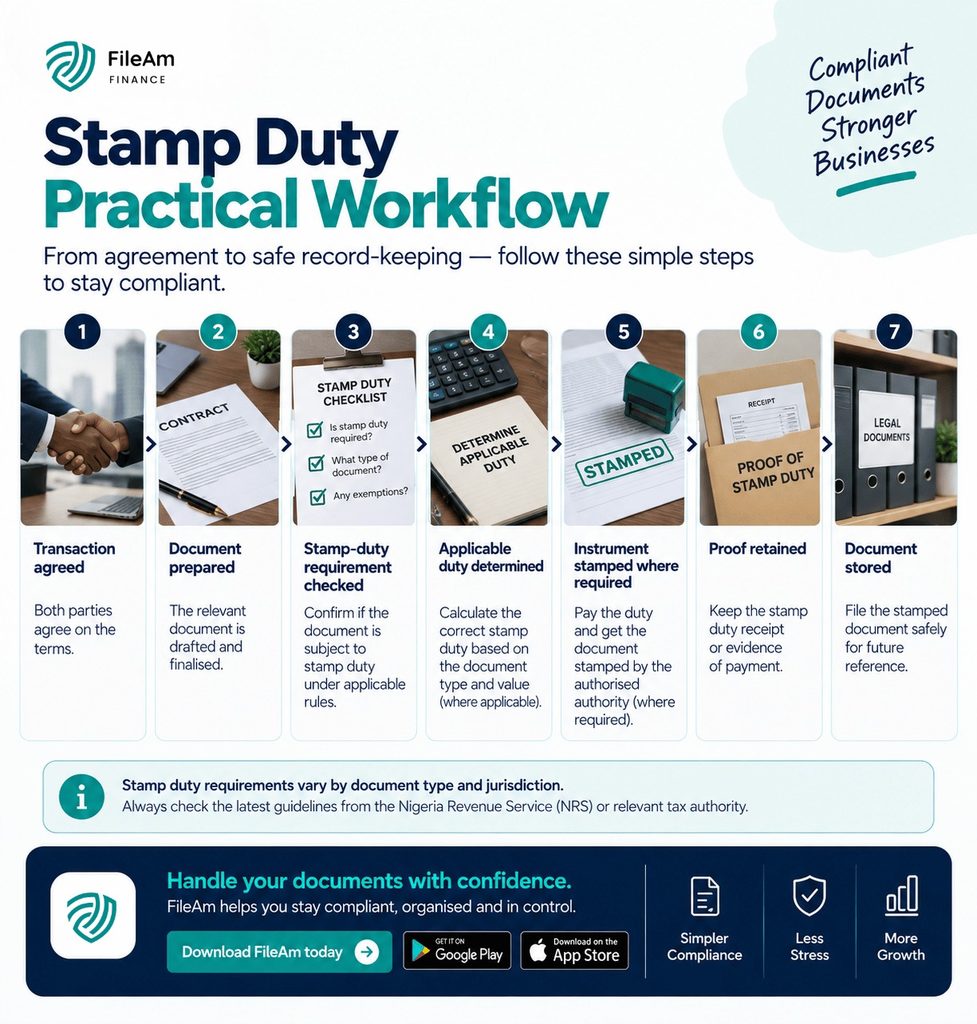
This is much better than waiting until a bank, investor, auditor, regulator, lawyer, or tax authority asks for evidence of compliance.
What Happens When a Document Is Not Stamped?
This is where a seemingly small administrative omission can become a business problem.
The consequences depend on the particular instrument and the applicable law, but failure to comply with stamp-duty requirements can potentially create issues around:
- Penalties.
- Interest or additional charges.
- Enforcement.
- Use of the instrument in legal proceedings.
- Delays in completing related transactions.
- Additional administrative costs.
There is also a practical problem.
If a business discovers months later that a document should have been stamped, it may need to reconstruct the transaction, locate the original instrument, confirm the applicable duty, determine whether penalties apply, and obtain the necessary evidence of compliance.
That is far more inconvenient than dealing with the requirement when the document is first executed.
Stamp Duty and Legal Documents: Why Timing Matters
Suppose a company signs a lease for a new office.
The company is focused on moving equipment, setting up internet, paying staff, and getting operations running.
Six months later, the company needs to present the lease as part of a financing application.
The bank asks for properly executed and stamped documentation. Now the business has a problem it could have prevented earlier.
This is why stamp duty should be treated as part of the transaction lifecycle, not as an isolated tax task. The documents being created because of stamp duty transactions, and the compliance requirements attached to them are quite important.

Stamp Duty on Electronic Documents
Modern business transactions do not always happen with paper documents.
Contracts can be:
- Created digitally.
- Signed electronically.
- Exchanged by email.
- Stored in cloud systems.
- Executed between parties in different locations.
That does not automatically mean stamp-duty considerations disappear.
The fact that a document is electronic rather than printed does not, by itself, answer whether the underlying instrument is subject to the applicable stamp-duty rules.
Businesses operating digitally should therefore include stamp-duty checks in their electronic document workflows. This is particularly important for companies that execute large numbers of contracts remotely.
What Businesses Should Check Before Stamping a Document
Before dealing with stamp duty, the business should establish a few basic facts.
1. What type of document is it?
Identify whether it is an agreement, lease, transfer, deed, security instrument, receipt, or another type of instrument.
2. What transaction does it represent?
The title of a document does not always tell the whole story.
Understand what the parties are actually doing.
3. Who are the parties?
The identity and status of the parties can affect the applicable treatment.
4. Where does the transaction fall within the relevant law?
Determine whether the instrument is administered federally or falls within another applicable jurisdiction.
5. Is the instrument chargeable?
Not every document is necessarily subject to stamp duty.
6. Is there an exemption or special treatment?
Some instruments or transactions may qualify for exemptions or particular treatment.
7. What duty applies?
Only after the previous questions are answered should the business determine the applicable charge.
This order matters.
Trying to start with a percentage or flat fee without first identifying the instrument can lead to the wrong result.
What Information Should You Keep?
A business should be able to explain the stamp-duty position of an instrument long after the transaction has been completed.
That means keeping the relevant supporting documents together.
Depending on the transaction, this could include:
- The original agreement or instrument.
- Signed copies.
- Supporting contracts.
- Invoices or payment records.
- Evidence of the transaction value.
- Stamp-duty assessment or calculation.
- Proof of payment.
- Stamp-duty evidence or stamped instrument.
- Correspondence with the relevant authority.
- Legal or professional advice where applicable.
The goal is simple:
If someone asks, “Was this document properly stamped?”, the business should be able to answer without searching through five different email accounts.
Stamp Duty and Business Recordkeeping
This is where stamp duty connects directly with broader compliance management.
Imagine a company has:
- 50 supplier contracts.
- 15 leases.
- 20 service agreements.
- Several financing documents.
- Multiple transfer instruments.
If the business keeps all of them in random folders, it becomes difficult to know:
- Which documents require stamping.
- Which ones have already been stamped.
- Which payments were made.
- Which documents are still outstanding.
- Where the evidence is stored.
The tax issue becomes a document-management issue.
And that is why businesses that deal with many contracts need a system for tracking compliance documentation.
Common Stamp Duty Mistakes Businesses Make
Assuming Every Document Is Subject to the Same Charge
Stamp duty treatment depends on the nature of the instrument.
Waiting Until an Audit or Transaction to Check Compliance
By then, finding the right documents can become unnecessarily difficult.
Ignoring Electronic Documents
Digital execution does not automatically remove the need to consider stamp duty.
Losing Evidence of Payment
Paying a duty is only part of the compliance trail. The evidence needs to be preserved.
Confusing Stamp Duty With Other Taxes
Stamp duty is different from VAT, Companies Income Tax, Personal Income Tax, and Withholding Tax.
One transaction can sometimes raise more than one tax issue.
Treating the Document Title as the Whole Answer
A document called an “agreement” can represent different types of transactions.
The underlying substance matters.
Keeping Stamping Records Separately From the Transaction
The stamp-duty evidence should be connected to the contract or instrument it relates to.
What About Stamp Duty Charges?
This is where many people make the mistake of jumping straight into calculations.
Stamp duty charges can depend on the type of instrument, the transaction, the applicable rate or fixed duty, and other relevant conditions.
Some instruments may involve a fixed amount.
Others may be assessed based on the value of the transaction. Some may have special rules or exemptions.
So there is no single amount that can accurately answer:
“How much is stamp duty in Nigeria?” without knowing what document or transaction you are talking about.
Stamp Duty and Property Transactions
Property-related transactions are an area where businesses and individuals should pay particular attention.
A transaction involving property can generate several different legal and tax considerations.
Depending on the transaction, documents such as:
- Leases.
- Transfers.
- Deeds.
- Mortgages.
- Other property-related instruments.
may need to be reviewed for stamp-duty purposes.
The important point is that the tax treatment should be assessed based on the actual instrument rather than simply saying:
“It is a property transaction.”
A lease and a transfer are not necessarily treated in exactly the same way.
Stamp Duty for Companies and Corporate Transactions
Companies can encounter stamp duty in ordinary commercial operations.
For example, a business may enter into:
- Financing arrangements.
- Commercial leases.
- Service contracts.
- Asset transfers.
- Share-related transactions.
- Security arrangements.
- Other formal agreements.
This means stamp duty should be incorporated into corporate transaction planning.
When a legal or finance team is reviewing a major agreement, stamp duty should be one of the compliance questions considered before the document is finalized.
What If You Are Unsure Whether Stamp Duty Applies?
Never guess when it comes to tax compliance. If the business cannot determine whether an instrument is chargeable, it should review:
- The relevant legislation.
- Current guidance from the tax authority.
- The nature of the transaction.
- The parties involved.
- Any applicable exemption.
- Professional advice where the transaction is complex or high-value.
The Nigeria Revenue Service provides current tax information and taxpayer services through its official platforms.
For complex transactions, getting professional advice before execution is usually much cheaper than discovering a compliance issue after the transaction has been completed.
How FileAm Can Help With Stamp-Duty Documentation
Stamp duty is a tax issue, but much of the practical work surrounding it is documentation.
Businesses need to know:
- Which instrument was executed.
- When it was executed.
- What transaction it represents.
- Whether stamp duty was assessed.
- How much was paid.
- Where the proof is.
- Whether the stamped document has been preserved.
FileAm helps businesses organize financial and compliance documents in a structured digital environment.
For stamp-duty records, businesses can use a centralized document-management approach to keep relevant:
- Contracts.
- Agreements.
- Leases.
- Payment records.
- Stamp-duty evidence.
- Tax correspondence.
- Supporting transaction documents.
Instead of having the agreement in one folder and the proof of payment somewhere else, the supporting records can be organized around the transaction itself.
That can make future reviews, audits, financing applications, and internal compliance checks much easier.
A Simple Stamp-Duty Compliance Checklist
Before closing a transaction involving a formal instrument, ask:
- What document are we executing?
- What transaction does the document represent?
- Is the instrument subject to stamp duty?
- Which tax authority has jurisdiction?
- Is there an applicable exemption?
- What duty or charge applies?
- When should the instrument be stamped?
- Has the required duty been paid?
- Do we have proof of payment?
- Has the stamped document been preserved?
- Can we quickly retrieve all supporting documents?
If these questions are answered consistently, stamp duty becomes much easier to manage.
Frequently Asked Questions About Stamp Duty in Nigeria
1. Does stamp duty apply to electronic documents?
An electronic document should not automatically be assumed to be outside stamp-duty requirements. The underlying instrument and applicable law should be considered.
2. Is stamp duty the same as VAT?
No. Stamp duty and VAT are separate taxes with different purposes and rules. A transaction can potentially have more than one tax consideration.
3. Is stamp duty only for large businesses?
No. Individuals, small businesses, companies, and other parties can encounter stamp-duty obligations depending on the instruments they execute.
4. How much is stamp duty in Nigeria?
There is no single stamp-duty amount. Charges can be fixed or calculated as a percentage of the relevant value, depending on the instrument and transaction.
5. What is the stamp duty on property transfer?
A commonly referenced rate under the Stamp Duties Act schedule is 1.5% for conveyance or transfer on sale of property. The actual treatment should be confirmed against the current rules and specific transaction.
6. How much is stamp duty on a lease?
Traditional rates have varied according to the lease period: 0.78% for leases not exceeding 7 years, 3% for leases above 7 years but not exceeding 21 years, and 6% for leases over 21 years.
7. What is the stamp duty on a loan agreement?
A commonly referenced rate for loan capital is 0.125%, while mortgage and bond instruments have traditionally attracted different rates. The exact instrument should be identified before calculating the charge.
8. Is stamp duty a fixed amount or percentage?
It can be either. Some instruments attract fixed duties, while others are subject to ad valorem rates based on the relevant transaction value.
9. Is there stamp duty on electronic transfers?
Yes, the current framework provides for a ₦50 stamp duty on qualifying electronic receipts or transfers of ₦10,000 and above, subject to specified exemptions.
10. Does every business contract attract stamp duty?
No. The document and transaction must first be assessed to determine whether it is a dutiable instrument and what treatment applies.
11. When should stamp duty be paid?
Current guidance provides that instruments required to be stamped under the Nigeria Tax Act should be stamped within 30 days of execution.
12. How much is stamp duty in Nigeria?
There is no single amount that applies to every document. The applicable charge depends on the type of instrument, transaction, value where relevant, and applicable rules.
13.What happens if I fail to stamp a document?
The consequences depend on the particular instrument and applicable law, but non-compliance can lead to additional costs, penalties, enforcement issues, or difficulties using the document for certain purposes.
14. Do I need to keep proof of stamp-duty payment?
Yes. Businesses should retain evidence of payment or stamping together with the underlying instrument and supporting transaction records.
The Two Ways Stamp Duty Is Usually Charged
Most stamp-duty calculations fall into two broad categories.
1. Fixed Stamp Duty
A fixed duty means the charge is a specified amount rather than a percentage of the transaction value.
For example, historical schedules to the Stamp Duties Act have included fixed duties for certain agreements and instruments.
If the applicable fixed duty is ₦15,000, the calculation does not change simply because the underlying commercial transaction is worth ₦2 million or ₦20 million.
2. Ad Valorem Stamp Duty
Ad valorem means the duty is calculated according to the value of the transaction or consideration.
For example, if an instrument is subject to a 1.5% duty and the relevant value is ₦10 million:
₦10,000,000 × 1.5% = ₦150,000
This is why identifying the instrument is so important.
A fixed-duty instrument and an ad valorem instrument cannot be calculated in the same way.
Common Stamp Duty Charges in Nigeria
The following table gives examples of commonly referenced stamp-duty rates under the Stamp Duties framework. Because tax legislation and administrative rules can change, businesses should verify the applicable rate and treatment for the relevant instrument before making payment.
| Instrument/transaction | Typical duty treatment |
|---|---|
| Agreement under hand | Fixed duty |
| Contract note | 0.08% |
| Conveyance or transfer on sale of property | 1.5% |
| Assignment by way of security | 0.38% |
| Bond | 0.38% |
| Debenture | 0.375% |
| Mortgage | 0.38% |
| Loan capital | 0.125% |
| Increase in share capital | 0.75% |
| Marketable securities | 2.25% |
| Insurance policy | 0.08% |
| Lease | 0.78%–6%, depending on the lease period |
| Power of attorney | Fixed duty |
| Certain ordinary contracts | Fixed duty |
These figures are useful for understanding the structure, but they should not be treated as a substitute for checking the current law for a particular instrument. Some categories have specific conditions, exemptions, or different treatment depending on the transaction.
Stamp Duty on Property Transfers
Property transactions are one of the areas where stamp duty can become significant because the duty may be calculated as a percentage of the value or consideration involved.
For example, historical Stamp Duties Act schedules have provided a 1.5% ad valorem rate for conveyances or transfers on the sale of property.
Imagine a qualifying property transfer with a relevant value of ₦50 million.
At 1.5%:
₦50,000,000 × 1.5% = ₦750,000
That gives a stamp-duty amount of ₦750,000.
But there is an important warning here:
Do not calculate stamp duty on a property transaction simply by multiplying the purchase price by 1.5%.
The exact instrument, transaction structure, applicable valuation rules, exemptions, and current legal framework need to be considered.
A property sale, lease, mortgage, and security arrangement are different instruments and can have different stamp-duty treatment.
Stamp Duty Charges on Lease Agreements
Lease agreements are another area where the charge can vary substantially.
Under the traditional Stamp Duties Act schedule, the rate has depended on the duration of the lease:
- 0.78% where the lease period is not more than 7 years
- 3% where the lease period is more than 7 years but not more than 21 years
- 6% where the lease period is more than 21 years
This makes the lease period particularly important.
Example
Suppose a qualifying lease has a relevant value of ₦10 million and the applicable rate is 0.78%.
The calculation would be:
₦10,000,000 × 0.78% = ₦78,000
If a different lease falls into a category attracting 3%, the calculation changes:
₦10,000,000 × 3% = ₦300,000
The difference is substantial.
This is why businesses should not estimate stamp duty on a lease simply by looking at the rent amount. The duration and nature of the instrument matter.
Stamp Duty on Loan Agreements and Mortgages
Businesses that borrow money may also encounter stamp duty on relevant financing instruments.
Traditional rates have included:
- Loan capital: 0.125%
- Mortgage: 0.38%
- Bond: 0.38%
- Debenture: 0.375%
Example: Loan Instrument
Assume a qualifying loan instrument has a relevant value of ₦20 million and the applicable rate is 0.125%.
₦20,000,000 × 0.125% = ₦25,000
For a mortgage at 0.38% on ₦20 million:
₦20,000,000 × 0.38% = ₦76,000
Again, these are illustrations of how the percentage works. The actual liability depends on the specific instrument and current applicable provisions.
Stamp Duty on Share Capital
Companies can also encounter stamp-duty obligations when dealing with share capital.
A commonly referenced rate for increase in share capital is 0.75%.
For example, if a company increases its relevant share capital by ₦100 million:
₦100,000,000 × 0.75% = ₦750,000
This is particularly relevant when companies are:
- Raising new capital.
- Restructuring their shareholding.
- Increasing authorized or relevant share capital.
- Completing corporate financing transactions.
Companies should confirm the exact basis of assessment under the current rules before making payment.
Stamp Duty on Marketable Securities
Marketable securities can attract a different rate from ordinary contracts.
The traditional schedule has provided a 2.25% ad valorem rate for marketable securities.
Because financial instruments can have complex structures, this is another category where businesses should avoid relying on a generic stamp-duty percentage.
The exact nature of the security and transaction should be established first.
Stamp Duty on Contract Notes
Contract notes can also fall within the stamp-duty framework.
A commonly referenced rate is 0.08%.
For a qualifying transaction with a relevant value of ₦10 million:
₦10,000,000 × 0.08% = ₦8,000
The calculation looks simple, but the difficult part is determining whether the particular document and transaction fall within this category.
What About Ordinary Business Contracts?
This is where things become less straightforward.
Not every business contract is automatically subject to a percentage charge.
Traditional stamp-duty schedules have contained fixed duties for certain contracts, while other contracts have specific charges under the legislation.
For this reason, a company should not see an invoice for ₦5 million and immediately calculate 0.5%, 1%, or 1.5% as stamp duty.
There is no universal “business contract rate.”
The business first needs to identify the legal character of the instrument.
Why the Value of the Transaction Matters
For ad valorem instruments, the value or consideration is an important part of the calculation.
Consider two otherwise similar transactions.
Transaction A
Relevant value: ₦5 million
Applicable rate: 1.5%
Stamp duty = ₦75,000
Transaction B
Relevant value: ₦50 million
Applicable rate: 1.5%
Stamp duty = ₦750,000
The percentage has not changed.
The transaction value has.
That is the fundamental difference between a fixed duty and an ad valorem duty.
Does the Amount on the Invoice Always Determine Stamp Duty?
No.
This is one of the most important things to understand. The amount appearing on an invoice or contract does not automatically mean that it is the amount on which stamp duty must be calculated. Depending on the instrument, the relevant basis may be:
- Consideration.
- Value of property.
- Amount secured.
- Share capital.
- Rent or lease consideration.
- Another statutory basis.
The appropriate calculation therefore depends on the instrument and the applicable provisions.
Stamp Duty on Electronic Transfers and Receipts
Stamp-duty discussions are not limited to contracts and property.
Under the current tax framework, deposit banks and financial institutions are required to charge ₦50 stamp duty on electronic receipts or transfers of ₦10,000 and above, subject to specified exemptions. One notable exemption applies to money paid into one’s own account or electronic transfers between accounts belonging to the same owner within the same bank.
This is different from the ad valorem examples discussed earlier.
For example, if a qualifying electronic transfer is ₦100,000, the stamp duty is not calculated as 1% or 0.5%.
The relevant charge is the applicable ₦50 fixed duty, subject to the conditions and exemptions under the current rules.
Who Actually Pays Stamp Duty?
The party responsible for stamp duty can depend on the type of transaction.
Under the current framework, the responsible party can include the:
- Transferee in a transfer of real property.
- Beneficiary of a service.
- Person taking security in a transaction.
- Other party identified under the applicable rules.
This is important because the person paying the money for the transaction is not automatically the person legally responsible for the stamp duty in every situation.
The contract and applicable law should be reviewed before assigning the obligation.
When Should Stamp Duty Be Paid?
Timing matters.
Current tax guidance indicates that instruments required to be stamped under the Nigeria Tax Act should be stamped within 30 days of execution.
That means stamp duty should not be treated as something to sort out only when a document is urgently needed.
A better workflow is:
Prepare instrument → identify stamp-duty treatment → calculate applicable duty → pay/stamp within the required period → retain evidence.
This reduces the chance of late compliance and makes the document easier to retrieve later.
Are There Stamp Duty Exemptions?
Yes.
Not every document or transaction attracts stamp duty.
The current rules contain specific exemptions, and the treatment can depend on the nature of the instrument. This is especially important for businesses that process a high volume of documents.
Before charging stamp duty, ask: Is this instrument actually dutiable?
If the answer is no, calculating a percentage against it is unnecessary. If the answer is yes, then determine the correct category and rate.
What Happens If You Use the Wrong Stamp Duty Rate?
A wrong calculation can create problems in either direction.
If You Underpay
You may later have to deal with:
- Additional duty.
- Penalties.
- Interest or other charges.
- Administrative delays.
- Difficulty regularizing the instrument.
If You Overpay
The business may also create unnecessary costs and have to investigate whether a correction or recovery mechanism is available.
The lesson is simple: Don’t guess the rate.
The correct rate should be established from the instrument and applicable rules before payment.
Stamp Duty Charges vs Other Nigerian Taxes
Stamp duty is often confused with other taxes because one transaction can involve several tax considerations.
For example, a property transaction might involve stamp duty alongside other property-related charges.
A business contract could also raise VAT or withholding-tax questions depending on what is being purchased. These are not interchangeable.
| Tax | What it generally relates to |
|---|---|
| Stamp Duty | Certain instruments and transactions |
| VAT | Taxable supplies of goods and services |
| Withholding Tax | Tax deducted at source from specified payments |
| Companies Income Tax | Tax on taxable company profits |
| Personal Income Tax | Tax on taxable income of individuals |
Understanding this distinction prevents businesses from assuming that paying one tax automatically satisfies every tax obligation connected to the transaction.
How to Calculate Stamp Duty: The Basic Formula
For a percentage-based instrument, the basic calculation is:
Stamp Duty = Relevant Value × Applicable Rate
For example:
Relevant value = ₦25,000,000
Rate = 0.38%
₦25,000,000 × 0.38% = ₦95,000
For a fixed-duty instrument, however, you don’t multiply the transaction value by a percentage.
You simply apply the prescribed fixed amount, subject to the relevant rules.
This is why the first step in every stamp-duty calculation should be identifying the instrument category.
A Quick Stamp Duty Calculation Cheat Sheet
If you are checking a common transaction, this simplified guide can help you understand the calculation method:
Property transfer
If the applicable rate is 1.5%:
Property value × 1.5%
Lease
The applicable rate can depend on the lease period:
Relevant value × applicable lease rate
Loan capital
If the applicable rate is 0.125%:
Relevant amount × 0.125%
Mortgage
If the applicable rate is 0.38%:
Relevant amount × 0.38%
Contract note
If the applicable rate is 0.08%:
Relevant value × 0.08%
Share capital increase
If the applicable rate is 0.75%:
Relevant amount × 0.75%
These are examples based on commonly referenced statutory rates; businesses should confirm the current treatment before using them for an actual payment.
Why Businesses Should Keep Stamp Duty Records
Paying stamp duty is only one part of the process.
The business should also preserve evidence that connects the payment to the relevant document.
For example:
Contract → Assessment → Payment → Stamp evidence → Supporting documents
If those records are separated, a future audit or transaction review becomes much harder.
A proper recordkeeping system should allow a business to answer questions such as:
- Which document was stamped?
- When was it stamped?
- How much was paid?
- Who paid it?
- What transaction did it relate to?
- Where is the payment evidence?
- Where is the final stamped instrument?
This becomes increasingly important for companies with large numbers of contracts and commercial documents.
How FileAm Can Help With Stamp Duty Records
Calculating stamp duty may take only a few minutes. Finding the supporting document six months later can take considerably longer.
FileAm helps businesses organize financial and compliance documentation in one structured digital environment.

For stamp-duty compliance, businesses can organize:
- Agreements.
- Contracts.
- Leases.
- Property documents.
- Payment records.
- Stamp-duty evidence.
- Tax correspondence.
- Supporting transaction documents.
Instead of keeping the contract in one folder and the proof of payment in another, the business can maintain a clearer compliance trail around the transaction.
That makes it easier to retrieve documents during:
- Audits.
- Financial reviews.
- Financing applications.
- Regulatory checks.
- Internal compliance reviews.
For a growing business, this kind of organization can be just as important as getting the calculation right.
The Bottom Line: Don’t Start With the Percentage
The biggest mistake businesses make when looking at stamp duty charges in Nigeria is searching for one percentage that applies to everything.
There isn’t one.
A property transfer is not the same as a lease. A mortgage is not the same as a contract note. A share-capital transaction is not the same as an ordinary business agreement and a fixed-duty instrument is not calculated like an ad valorem instrument.
The safest process is:
1. Identify the instrument.
2. Understand the transaction it represents.
3. Confirm whether stamp duty applies.
4. Identify the correct rate or fixed charge.
5. Determine the correct calculation base.
6. Calculate and pay the applicable duty.
7. Keep the payment and stamping evidence with the original document.
The figures can change as tax legislation and administrative rules evolve, so businesses should verify the current applicable treatment before making an actual payment. The Nigeria Revenue Service provides official tax information and taxpayer services through its current platforms.
Ultimately, knowing the percentage is only half the job.
Knowing which percentage applies to your document is what prevents costly mistakes.
Conclusion
Stamp duty is easy to overlook because it often sits behind the main event.
The business is thinking about the property, contract, financing, partnership, or commercial deal. Stamp duty appears to be a smaller administrative detail.
But that “small detail” can become a problem if it is ignored.
The better approach is to make stamp-duty review part of the transaction itself.
Before signing or finalizing a document, determine what the instrument represents, whether stamp duty applies, which authority has jurisdiction, what requirements must be met, and what evidence needs to be retained.
And don’t start with the question “How much do we pay?”
Start with:
“What exactly are we stamping, and what rules apply to it?”
Once that is clear, determining the applicable charge becomes much easier.
Leave a Reply