
Has there been an increase in corporate tax in Nigeria? This question is increasingly relevant to business owners, investors, finance teams, and anyone trying to understand the changing cost of doing business in the country.
The answer is however more complicated than simply saying that Nigeria increased its corporate tax rate.
Under the Nigeria Tax Act 2025, which commenced in January 2026, the corporate income tax rate for companies other than small companies is 30%. Small companies are subject to a 0% corporate income tax rate under the new framework. At the same time, a new 4% Development Levy applies to assessable profits of qualifying companies, while some other corporate tax provisions have also changed.
Consequently, businesses need to look beyond the headline corporate income tax rate. The more important question is what is the total tax burden on companies, and what does that burden mean for investment, prices, employment, profitability, and economic growth?
That distinction is at the heart of understanding Nigeria’s current tax reforms. Nigeria’s current tax reforms are anchored by four landmark Acts signed into law in June 2025 and fully effective from January 1, 2026. Managed via the Presidential Committee on Fiscal Policy & Tax Reforms, the reforms repeals over 50 fragmented laws to create a unified, digital-first fiscal framework aimed at easing burdens on small businesses and low-income earners.
The 4 landmark Acts are:
Joint Revenue Board Act (JRBA): which establishes a central framework for intergovernmental tax coordination across federal and sub-national
Nigeria Tax Act (NTA): which consolidates income, asset, transaction, and corporate tax rules into a single code.
Nigeria Tax Administration Act (NTAA): which harmonizes operational procedures and compliance standards.
Nigeria Revenue Service (Establishment) Act (NRSA): which replaces the former Federal Inland Revenue Service (FIRS) with the tech-enabled Nigeria Revenue Service (NRS).
Has There Been an Increase in Corporate Tax in Nigeria?
For many established companies, the headline corporate income tax rate remains 30% under the new Nigeria Tax Act. The significant change is therefore not simply a move from one corporate income tax rate to a dramatically higher rate.
Instead, the new framework changes the composition and calculation of the overall corporate tax burden.
The Nigeria Tax Act introduces a 4% Development Levy on the assessable profits of qualifying companies. The levy replaces several separate levies, including the Tertiary Education Tax, NITDA levy, NASENI levy, and Police Trust Fund levy. Small companies and non-resident companies are excluded from this Development Levy.
There is also a 15% minimum effective tax rule for multinational enterprise groups and companies with annual turnover of at least ₦20 billion where the applicable effective tax rate falls below 15%.
Another notable change concerns capital gains. Under the new framework, corporate capital gains are brought into the corporate income tax structure, effectively aligning the rate with the 30% corporate income tax rate rather than the previous 10% capital gains tax rate for companies.
So the response to whether there has been an increase in corporate tax in Nigeria is:
Nigeria has not simply increased the standard CIT rate for all companies, but the overall tax treatment and potential tax burden for many businesses have changed.
This distinction matters enormously for economic analysis.
Corporate Tax Is More Than a Percentage
A common mistake in tax discussions is to look at the corporate income tax rate and assume it represents the entire tax burden faced by a company. It does not. A company operates within a much larger fiscal environment.

Its financial burden can include corporate income tax, development levies, withholding taxes, VAT-related costs, payroll obligations, customs duties, state and local government charges, regulatory fees, and the administrative cost of maintaining compliance.
Some of these are technically taxes paid by different parties or collected on behalf of government, but they can still influence the cost of operating a business.
This is why tax burden analysis should focus on the relationship between taxes and a company’s actual economic activity.
For example, two businesses can both face a 30% corporate income tax rate while experiencing very different effective tax burdens.
One may benefit from capital allowances, incentives, deductible expenses, tax losses, or other provisions. Another may have a much smaller margin and fewer opportunities to offset its taxable income.
The tax rate is identical. The economic impact is not.
The Economic Impact of Corporate Taxation
Corporate taxation has an important role in any economy. Government needs revenue to finance infrastructure, education, healthcare, security, public administration, and other services. Without sufficient tax revenue, government becomes more dependent on borrowing, volatile commodity revenues, or other sources of financing.

Nigeria’s fiscal position makes this particularly important.
The IMF reported that Nigeria’s company income tax and VAT revenues were on target in 2025, even though oil and gas revenue fell short of budget expectations.
This highlights one of the strongest arguments for effective corporate taxation: a broader and more predictable tax base can make public finances less dependent on oil revenue.
But taxation also has a cost. When taxes increase the cost of doing business, companies may respond by reducing investment, slowing expansion, cutting costs, raising prices, or delaying hiring.
The economic challenge is therefore finding the point at which taxation raises meaningful government revenue without weakening the productive capacity that generates that revenue.
How Corporate Tax Can Affect Investment
Investment decisions are rarely based on tax rates alone.
Investors consider infrastructure, electricity, transport, access to finance, market size, labour costs, political stability, regulatory certainty, exchange rates, and taxation.
Taxation nevertheless matters because it affects the return an investor expects to receive.
Imagine a company considering a ₦10 billion expansion project.
If the project generates substantial taxable profits, corporate taxation reduces the amount available to shareholders or to reinvest in the business.
That does not automatically mean the project becomes unattractive.
If Nigeria offers a sufficiently large market, strong infrastructure, skilled workers, and predictable regulation, investors may still proceed.
But if tax costs are combined with expensive financing, unreliable electricity, high logistics costs, currency volatility, and regulatory uncertainty, the cumulative burden can become significant.
This is why corporate taxation should not be analysed in isolation.
An assessment of the Nigerian tax reforms notes that businesses have historically faced challenges including multiple taxation, difficulty obtaining tax refunds, inability to claim certain input costs, and high interest rates. It argues that simplifying tax administration could reduce some of the wider costs of doing business and potentially support investment and productivity.
The Difference Between Tax Rate and Tax Burden
A tax rate tells you the percentage applied under a specific tax rule. While a tax burden asks the broader question: How much does taxation actually reduce the economic resources available to a business or taxpayer? For companies, this can be examined through measures such as:
- Tax paid relative to profit.
- Tax paid relative to revenue.
- Effective tax rate.
- Cash tax paid.
- Tax expense relative to earnings.
- Compliance and administrative costs.
- Taxes embedded in the company’s supply chain.
- The effect of taxation on investment returns.
This broader approach produces a more realistic picture.
For example, a company with a statutory CIT rate of 30% could have an effective tax rate that differs substantially from 30% depending on the structure of its income, allowable deductions, incentives, losses, capital allowances, and other tax provisions.
The Nigeria Tax Act itself recognises this distinction by establishing a minimum effective tax rate of 15% for certain large companies and multinational groups.
Who Carries the Corporate Tax Burden?
One of the most interesting economic questions is whether corporations actually bear the entire cost of corporate taxation. They may not.
A company can respond to a higher tax burden in several ways.
It might:
Increase prices.
Part of the tax cost could potentially be passed to consumers.
Reduce wages or slow hiring.
Businesses facing lower after-tax profitability may become more cautious about expanding their workforce.
Reduce dividends.
Shareholders may receive less after-tax income.
Reduce investment.
Companies may postpone new factories, branches, technology investments, or expansion projects.
Accept lower profits.
In highly competitive markets, businesses may not have enough pricing power to pass costs to customers.
The actual incidence depends on the industry, level of competition, labour market conditions, consumer demand, and the company’s financial structure. That means the economic impact of corporate taxation can spread far beyond the company paying tax.
Small Businesses and the New Tax Structure
The new framework also creates an important distinction between small and larger businesses.
Under the Nigeria Tax Act 2025, a small company is defined using a turnover threshold of ₦100 million and a fixed-asset threshold of ₦250 million. Small companies receive a 0% corporate income tax rate and are exempt from the Development Levy.
This is potentially significant for Nigeria’s small-business ecosystem.
Small businesses frequently have thinner margins, less access to capital, and fewer administrative resources than large corporations.
Exempting qualifying small companies from corporate income tax can therefore reduce their immediate tax burden and potentially leave more cash available for:
- Hiring employees.
- Purchasing equipment.
- Expanding operations.
- Building working capital.
- Developing products.
- Entering new markets.
However, the threshold also creates a transition issue.
As businesses grow, crossing the relevant threshold can change their tax position. That makes tax planning and financial forecasting particularly important for growing companies.
The 4% Development Levy: Higher Burden or Simpler System?
The Development Levy is one of the most important provisions to consider when analysing whether corporate taxation has effectively increased.
The levy is 4% of assessable profits for qualifying companies. It consolidates several previous levies into one mechanism.
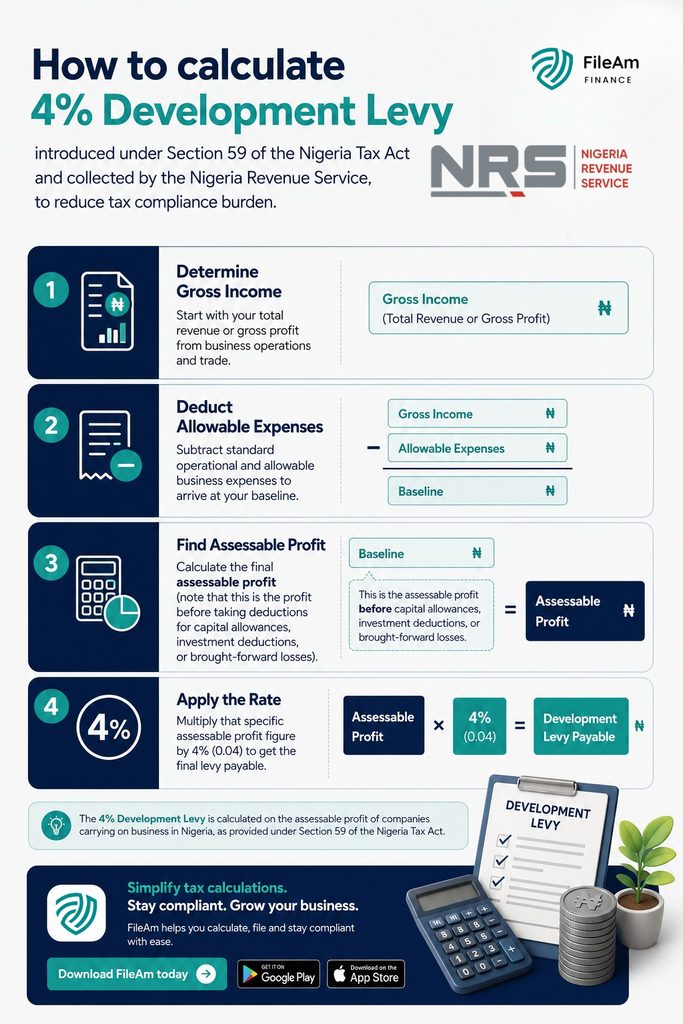
From one perspective, this represents an additional visible tax charge. From another, it is a simplification of several existing obligations.
That distinction is crucial. If a company previously paid multiple levies that collectively represented a similar or substantial burden, replacing them with one 4% levy may simplify compliance without necessarily creating a proportionate increase in the company’s overall tax cost.
The economic value of the reform therefore depends partly on what businesses were paying before and how the new system operates in practice.
In other words, a new tax label does not automatically equal a new economic burden.
Corporate Tax and Consumer Prices
One of the biggest concerns about higher business taxation is inflation.
If the cost of operating a company rises, businesses may attempt to recover that cost through higher prices. This is particularly relevant in industries where margins are already under pressure.
However, companies cannot always pass taxes directly to customers. In a highly competitive market, raising prices may cause customers to switch to competitors. A business may therefore absorb part of the tax cost through lower profit margins. This creates a balancing act.
If corporate taxes are too low, government may struggle to fund essential public services.
If the combined tax and regulatory burden becomes too high, businesses may become less competitive, investment can weaken, and prices may rise.
The objective should therefore be efficient taxation, not simply maximum taxation.
Tax Revenue and Nigeria’s Economic Development
There is another side to the tax-burden discussion that should not be ignored.
Corporate taxes can finance public investment.
The 4% Development Levy, for example, is earmarked for several areas, including tertiary education, student loans, information technology, science and engineering infrastructure, defence and security, and cybersecurity.
If these revenues are effectively collected and efficiently deployed, the resulting public investment can generate economic benefits for businesses.
A company may pay more tax today but benefit from:
- Better infrastructure.
- A more skilled workforce.
- Improved digital systems.
- Better security.
- Greater access to education.
- Stronger public institutions.
This creates an important economic principle:
The impact of taxation depends not only on how much government collects, but also on what government does with the money. Poorly spent tax revenue creates a heavier burden. Productively invested tax revenue can create economic value that partly offsets the cost of taxation.
What Businesses Should Do About the Changing Tax Burden
Businesses should stop viewing corporate tax as an annual accounting exercise. It should be treated as a strategic financial variable. Companies need to understand:
- Their applicable tax classification.
- Their taxable and assessable profits.
- Available deductions, losses, allowances, and incentives.
- The effect of the Development Levy.
- Potential minimum effective tax rules.
- The treatment of capital gains.
- Their compliance obligations.
- The effect of taxation on cash flow and investment decisions.
This is where digital tax management becomes valuable.
For businesses using a SaaS platform such as FileAm, tax information can become part of an ongoing financial workflow rather than something reconstructed at the end of the accounting period.
FileAm and Tax Burden Analysis
FileAm’s opportunity is larger than simply helping businesses file tax returns.
The platform can position itself around tax visibility. For a business owner, knowing the tax rate is useful.
Knowing how tax affects the company’s cash flow is better.
Knowing how the company’s tax position changes as revenue, expenses, profit, and investment change is even more valuable.
That is where a SaaS platform as FileAm can help.
FileAm can make tax data easier to organise and interpret, helping businesses understand their potential obligations before they become a year-end surprise.
The product proposition can therefore move from:
“File your taxes.”
to:
“Understand your tax position and manage your business with greater financial visibility.”
This is particularly valuable in an environment where tax rules are changing.
The Bigger Question: Is Nigeria’s Corporate Tax Burden Too High?
There is no answer. For some businesses, the new framework may represent a more predictable and streamlined tax environment.
For others, especially larger profitable businesses affected by the Development Levy, capital gains changes, and other provisions, the overall tax burden may feel higher or more complex.
The important economic question is not simply whether companies pay more tax. It is whether the tax system creates the right balance between government revenue and private-sector productivity.
Nigeria needs revenue. Businesses need room to invest. Workers need jobs. Consumers need affordable products. Investors need competitive returns.
Government therefore faces a difficult optimisation problem: collect enough revenue to finance development without creating a tax environment that discourages the investment and production required to expand the economy.
Conclusion
So, has there been an increase in corporate tax in Nigeria?
The answer requires more nuance than a simple yes or no.
The standard corporate income tax rate for companies other than small companies remains 30% under the Nigeria Tax Act 2025. However, the new framework changes the overall corporate tax landscape through measures including a 4% Development Levy, a 15% minimum effective tax rule for certain large businesses and multinational groups, and changes to the taxation of corporate capital gains.
The real issue is therefore tax burden analysis.
How much tax does a company actually pay? How does taxation affect investment? Can businesses pass costs to consumers? Does the government use tax revenue productively? Does the new system reduce administrative complexity? And does the overall framework make Nigeria more or less attractive for businesses and investors?
These questions matter more than the corporate tax rate.
For FileAm, knowing how much tax a company actually pays, creates an opportunity to make tax management more intelligent and practical. Instead of treating tax as a compliance task that appears once a year, businesses can use digital tools to understand their tax exposure continuously and make better financial decisions.
Ultimately, the success of corporate taxation should not be measured only by how much government collects. It should also be measured by whether Nigeria can collect sustainable revenue while preserving the investment, productivity, entrepreneurship, and job creation needed to grow the economy.
Leave a Reply