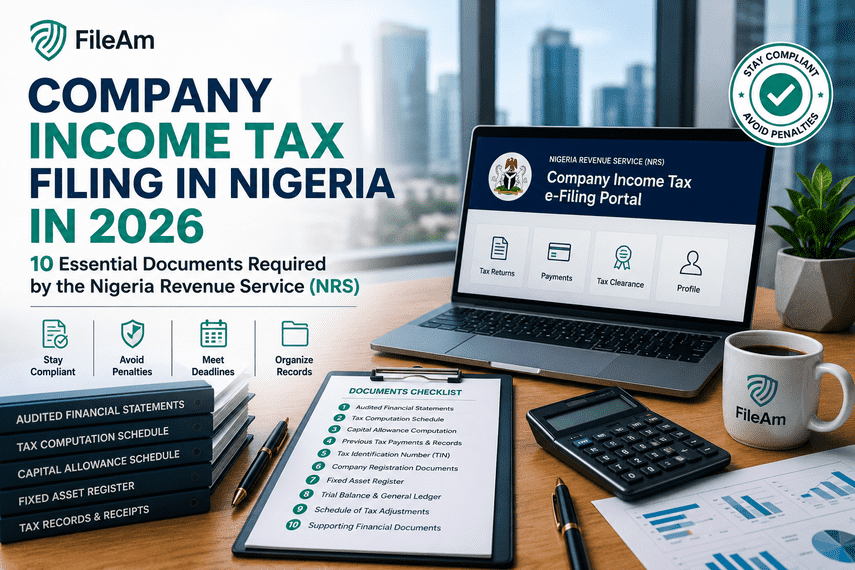
Preparing the Documents Required When Filing Company Income Tax is one of the most important steps every Nigerian business must complete before submitting its annual Company Income Tax (CIT) return. Whether your business is a startup, a growing SME, or a large corporation, having the right documentation ready before filing significantly reduces delays, minimizes errors, and improves overall tax compliance.
In 2026, businesses are expected to maintain more organized financial records than ever before. As regulatory compliance continues to evolve, companies should not wait until filing deadlines approach before gathering tax documents. Instead, successful organizations prepare their records throughout the financial year, making annual tax filing faster, more accurate, and less stressful.
One of the biggest reasons companies experience delays during Company Income Tax filing is incomplete documentation. Missing financial statements, inaccurate Tax Identification Numbers (TIN), incomplete tax computation schedules, or unsupported financial figures often result in additional administrative work and may delay successful filing.
Understanding the Documents Required When Filing Company Income Tax also improves financial management. Organized documentation allows finance teams to prepare accurate financial statements, reconcile accounting records efficiently, calculate taxable income correctly, and respond confidently to requests for additional information where necessary.
This comprehensive guide explains the 10 essential Documents Required When Filing Company Income Tax with the Nigeria Revenue Service (NRS) in 2026, why each document matters, common documentation mistakes businesses should avoid, and practical tips for maintaining filing readiness throughout the year.
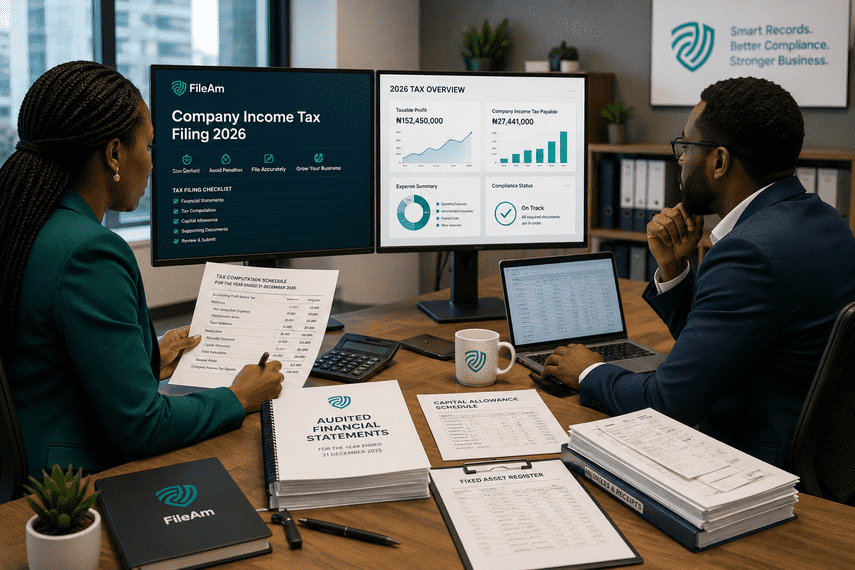
Why Proper Documentation Is Essential for Company Income Tax Filing
Corporate tax filing is much more than completing forms and calculating tax liabilities. Every figure reported in a Company’s Income Tax Return should be supported by accurate financial records and relevant documentation.
Proper documentation helps businesses:
- Prepare Company Income Tax Returns more efficiently.
- Reduce filing errors and inconsistencies.
- Support tax computations with verifiable records.
- Improve readiness for compliance reviews.
- Minimize delays caused by missing information.
- Strengthen overall financial management.
Businesses that organize their records continuously throughout the accounting year generally experience a much smoother filing process than companies attempting to reconstruct financial information shortly before submission.
Accurate documentation also demonstrates responsible financial management and supports better corporate governance.
Benefits of Preparing Tax Documents Early
Many businesses only begin gathering their tax records a few weeks before filing deadlines.
Unfortunately, this approach often leads to:
- Missing invoices.
- Incomplete accounting records.
- Delayed financial statements.
- Incorrect tax computations.
- Filing errors.
- Last-minute pressure.
Preparing documentation throughout the accounting year offers several advantages.
Faster Company Income Tax Filing
When financial documents are already organized, accountants spend less time locating records and more time reviewing financial information.
This significantly shortens the overall filing process.
Improved Filing Accuracy
Well-organized documentation reduces the likelihood of:
- duplicate records;
- inconsistent figures;
- omitted transactions; and
- computational errors.
Better documentation directly contributes to more accurate Company Income Tax Returns.
Better Financial Management
Organized records are valuable beyond tax filing.
Management can use accurate financial information to:
- evaluate profitability;
- monitor cash flow;
- prepare budgets;
- manage expenses; and
- make informed business decisions.
Strong financial systems therefore support both compliance and business growth.
Easier Regulatory Verification
During compliance reviews or financial audits, businesses with complete documentation can provide requested information quickly.
This improves confidence in reported figures and reduces administrative delays.
The 10 Essential Documents Required When Filing Company Income Tax
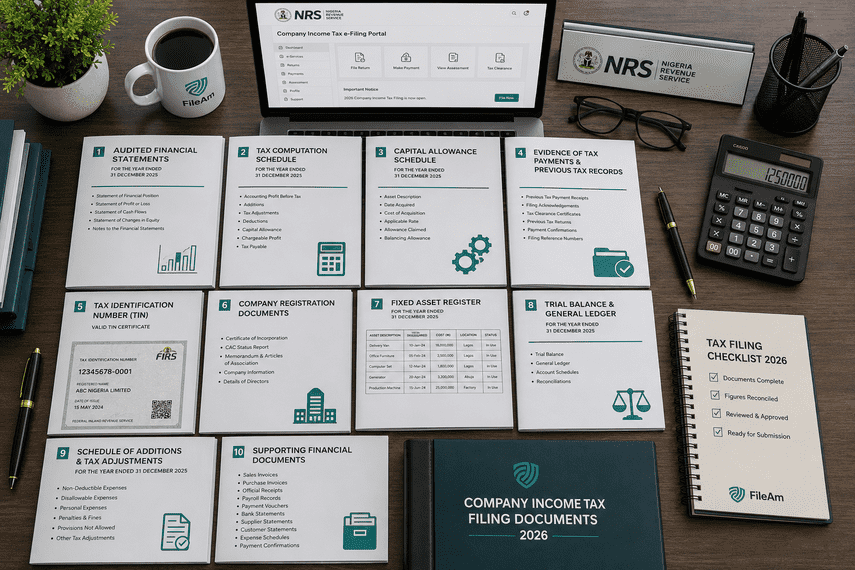
Document #1 — Audited Financial Statements
Among all the Documents Required When Filing Company Income Tax, audited financial statements remain one of the most important.
These statements provide a comprehensive picture of the company’s financial performance during the accounting year and serve as the primary reference for tax computation.
A complete audited financial statement typically contains:
- Statement of Financial Position (Balance Sheet)
- Statement of Profit or Loss
- Statement of Cash Flows
- Statement of Changes in Equity
- Notes to the Financial Statements
These reports help determine:
- company revenue;
- operating expenses;
- taxable income;
- retained earnings; and
- overall financial position.
Without properly prepared financial statements, preparing an accurate Company Income Tax Return becomes significantly more difficult.
Businesses should therefore complete financial reporting well before filing season begins.
Document #2 — Tax Computation Schedule
Another essential item among the Documents Required When Filing Company Income Tax is the Tax Computation Schedule.
Many business owners mistakenly believe accounting profit automatically represents taxable profit.
In practice, this is rarely the case.
A Tax Computation Schedule explains how the company moved from accounting profit to taxable profit after making the adjustments required under applicable tax regulations.
A properly prepared computation typically includes:
- Accounting profit before tax
- Non-deductible expenses
- Allowable deductions
- Tax adjustments
- Capital allowance claims
- Chargeable profits
- Final tax payable
Preparing this schedule carefully helps demonstrate how the company’s final tax liability was calculated.
It also improves transparency and makes future compliance reviews significantly easier.
Document #3 — Capital Allowance Computation
Companies that own qualifying business assets should prepare a Capital Allowance Computation as part of the Documents Required When Filing Company Income Tax.
Because accounting depreciation is generally treated differently for tax purposes, businesses often calculate capital allowances on qualifying assets instead.
Typical qualifying assets include:
- Manufacturing equipment
- Office furniture
- Computers
- Vehicles
- Factory machinery
- Production equipment
- Certain qualifying buildings
A complete Capital Allowance Schedule should contain:
- Asset description
- Purchase date
- Cost of acquisition
- Applicable allowance rate
- Annual allowance claimed
- Remaining tax written-down value
Maintaining an updated asset register throughout the accounting year makes preparation of this schedule much easier.
It also improves financial reporting and strengthens asset management across the business.
Document #4 — Evidence of Previous Tax Payments and Filing Records
Another important item among the Documents Required When Filing Company Income Tax is evidence of previous tax payments and historical filing records.
Many businesses focus only on preparing the current year’s return, but historical tax records are equally valuable because they provide continuity and help verify information reported in previous accounting periods.
Businesses should maintain organized copies of:
- Previous Company Income Tax payment receipts
- Previous filing acknowledgements
- Tax Clearance Certificates
- Previous Company Income Tax Returns
- Payment confirmation receipts
- Filing reference numbers
- Official correspondence relating to previous filings
Keeping these records allows finance teams to reconcile historical information, verify earlier submissions, and resolve discrepancies quickly if questions arise during future compliance reviews.
Historical documentation also reduces the likelihood of duplicated filings or inconsistencies between reporting periods, making annual Company Income Tax preparation more efficient.
Document #5 — Valid Tax Identification Number (TIN)
A valid Tax Identification Number (TIN) is one of the most fundamental Documents Required When Filing Company Income Tax.
Before beginning the filing process, businesses should verify that their TIN information is accurate and corresponds with their current registration details.
Companies should confirm that:
- the TIN is active;
- company information attached to the TIN is accurate;
- registered company names are correctly reflected;
- registration details match corporate records; and
- there are no outstanding inconsistencies requiring correction.
Incorrect TIN information is a surprisingly common cause of filing delays.
Simple administrative errors, such as outdated company information or incorrect registration details, may interrupt the filing process and require additional verification before returns can be processed.
For this reason, businesses should include TIN verification as part of their annual tax preparation checklist.
Document #6 — Company Registration Documents
Corporate registration documents are another essential category within the Documents Required When Filing Company Income Tax.
These documents confirm the legal identity of the business and support information contained in annual tax filings.
Businesses should maintain updated copies of:
- Certificate of Incorporation
- CAC Status Report (where applicable)
- Memorandum and Articles of Association
- Company registration information
- Details of directors where required
- Any relevant corporate registration updates
These records help establish the legal identity of the company and ensure that information submitted during tax filing corresponds with official corporate records.
For newly incorporated businesses, organizing registration documents immediately after incorporation simplifies future compliance and reduces administrative challenges during annual filing.
Document #7 — Fixed Asset Register
Every business that owns qualifying assets should maintain an accurate Fixed Asset Register.
This register supports both financial reporting and tax computation, making it one of the most valuable Documents Required When Filing Company Income Tax.
A comprehensive Fixed Asset Register should include:
- Asset description
- Date of acquisition
- Purchase value
- Physical location
- Asset category
- Disposal information where applicable
- Current asset status
Maintaining an updated register provides several important benefits.
It allows businesses to:
- prepare Capital Allowance Schedules more efficiently;
- improve internal asset management;
- reconcile financial statements accurately;
- support tax computations; and
- maintain reliable financial records throughout the accounting year.
Rather than updating the register only during tax season, businesses should record every acquisition and disposal as transactions occur.
This practice significantly reduces year-end preparation work.
Document #8 — Trial Balance and General Ledger
The Trial Balance and General Ledger provide the detailed accounting information required to prepare annual financial statements and Company Income Tax computations.
For many accountants, these records represent the starting point of the tax preparation process.
A properly maintained Trial Balance helps businesses:
- verify account balances;
- reconcile financial records;
- identify accounting inconsistencies;
- support financial statement preparation; and
- confirm tax computation accuracy.
The General Ledger complements the Trial Balance by providing transaction-level detail throughout the accounting period.
Together, these records enable finance teams to verify the accuracy of reported financial information before preparing annual returns.
Without these accounting records, producing reliable Company Income Tax Returns becomes significantly more difficult.
Document #9 — Schedule of Additions and Tax Adjustments
Another important item among the Documents Required When Filing Company Income Tax is the Schedule of Additions and Tax Adjustments.
Accounting profit is not always the same as taxable profit. During Company Income Tax preparation, businesses often need to adjust their accounting figures to comply with applicable tax rules.
A properly prepared adjustment schedule helps explain these differences and provides transparency in the tax computation process.
Common adjustments include:
- Non-deductible expenses
- Disallowable business expenses
- Personal expenses charged to the business
- Penalties and fines
- Provisions and reserves that are not tax deductible
- Other adjustments required under applicable tax rules
Preparing this schedule improves the clarity of the Company’s tax computation and makes it easier to demonstrate how the final taxable profit was determined.
It also reduces the likelihood of questions during compliance reviews because every adjustment can be traced back to supporting accounting records.
Businesses should prepare these schedules alongside their annual financial statements rather than attempting to reconstruct them during filing season.
Document #10 — Supporting Financial Documents
Completing the list of Documents Required When Filing Company Income Tax are the supporting financial documents that provide evidence for every major transaction reported in the Company’s financial statements.
Supporting documentation strengthens the credibility of reported figures and enables businesses to respond confidently to requests for verification.
Important supporting records include:
- Sales invoices
- Purchase invoices
- Official receipts
- Payroll records
- Payment vouchers
- Bank statements
- Supplier statements
- Customer statements
- Expense schedules
- Payment confirmations
Maintaining these documents in an organized filing system makes annual Company Income Tax preparation significantly easier.
Rather than searching through paper files immediately before submission, businesses with structured documentation can retrieve information quickly and prepare complete tax returns with greater confidence.
Why Maintaining These Documents Throughout the Year Matters
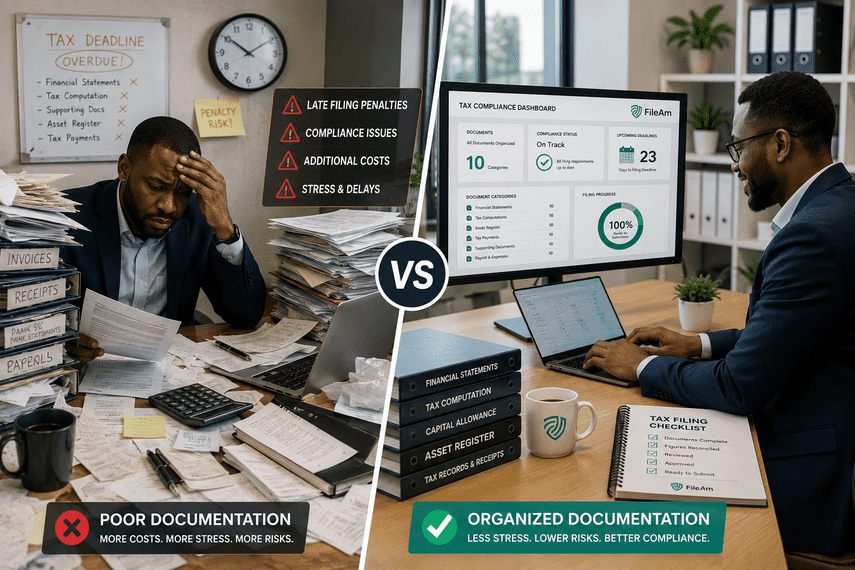
Many businesses mistakenly believe that tax documentation only becomes important shortly before filing deadlines.
In reality, maintaining the Documents Required When Filing Company Income Tax throughout the accounting year offers substantial operational advantages.
Reduces Last-Minute Pressure
Businesses that organize financial records continuously avoid the stress associated with locating months of missing documentation during filing season.
Instead of reconstructing financial information, finance teams can focus on reviewing and validating existing records.
Improves Financial Accuracy
Continuous documentation reduces:
- duplicate transactions;
- omitted expenses;
- missing revenue records;
- inconsistent reporting; and
- computational errors.
Accurate records naturally produce more reliable tax returns.
Strengthens Internal Financial Control
Well-maintained documentation improves more than tax compliance.
It also supports:
- budgeting;
- financial reporting;
- management decision-making;
- audit readiness; and
- operational transparency.
Businesses with strong recordkeeping systems generally experience better overall financial management.
Simplifies Collaboration With Professionals
Annual Company Income Tax filing often involves accountants, auditors, tax advisers, and finance managers.
Organized documentation allows these professionals to work more efficiently because the information they require is readily available.
This reduces preparation time while improving filing quality.
Common Documentation Mistakes That Delay Company Income Tax Filing
Even businesses with experienced finance teams occasionally encounter documentation problems.
Some of the most common mistakes include:
Missing Audited Financial Statements
Incomplete financial statements delay tax computation and may interrupt the filing process.
Incomplete Tax Computation Schedules
Businesses sometimes prepare tax returns without fully documenting the adjustments used to calculate taxable profit.
This creates unnecessary compliance questions later.
Incorrect TIN Information
Outdated registration details or incorrect Tax Identification Numbers frequently cause avoidable filing delays.
Missing Supporting Documents
Invoices, receipts, payroll schedules, bank statements, and supplier records should all be maintained consistently throughout the year.
Missing supporting documentation weakens the reliability of reported financial information.
Poor Asset Documentation
Incomplete Fixed Asset Registers make Capital Allowance Computations significantly more difficult.
Maintaining accurate asset records throughout the accounting year avoids this problem.
Waiting Until Filing Season
Perhaps the most common mistake is postponing document preparation until filing deadlines are close.
Businesses that prepare documentation continuously experience fewer filing problems and significantly less administrative pressure.
How SMEs Can Prepare Before Filing Season
One of the biggest mistakes made by many small and medium-sized enterprises is treating tax preparation as a once-a-year activity.
Successful businesses prepare for Company Income Tax filing throughout the accounting year.
Some practical strategies include:
Create Dedicated Tax Documentation Folders
Separate financial records into logical categories such as:
- Financial Statements
- Tax Computation
- Payroll
- Bank Statements
- Invoices
- Asset Registers
- Previous Tax Returns
This makes retrieval much faster when filing begins.
Reconcile Financial Records Monthly
Waiting until year-end to reconcile financial information increases the likelihood of errors.
Monthly reconciliation allows businesses to identify inconsistencies early before they become major compliance issues.
Update Asset Registers Continuously
Whenever equipment, vehicles, computers, or other qualifying assets are acquired or disposed of, businesses should immediately update their Fixed Asset Register.
This prevents unnecessary work during Capital Allowance preparation.
Review Financial Statements Before Filing Season
Rather than preparing financial statements immediately before filing deadlines, businesses should complete internal financial reviews early.
This provides sufficient time to correct accounting issues before tax computations begin.
Conduct Internal Documentation Reviews
Before filing Company Income Tax Returns, finance teams should verify that all Documents Required When Filing Company Income Tax are complete and internally consistent.
A simple pre-filing checklist can significantly reduce omissions and administrative delays.
How Technology Simplifies Company Income Tax Documentation
Technology has transformed how businesses organize financial information and prepare tax returns.
Instead of relying entirely on manual filing systems, many companies now use digital platforms to improve document management and compliance readiness.
Digital recordkeeping offers several advantages:
- Secure storage of financial records
- Faster document retrieval
- Reduced paper-based filing
- Better collaboration between finance teams and accountants
- Reduced risk of document loss
- Improved visibility into financial information
As businesses grow, digital document management becomes increasingly valuable because larger organizations must manage significantly more financial information than smaller businesses.
A structured digital system allows finance teams to retrieve supporting records quickly, reducing preparation time during annual Company Income Tax filing.
How FileAm Helps Businesses Organize the Documents Required When Filing Company Income Tax

Preparing Company Income Tax Returns becomes much easier when financial records are organized throughout the year instead of only during filing season.
FileAm helps businesses centralize their financial documentation, making it easier to maintain the Documents Required When Filing Company Income Tax in one secure location.
With FileAm, businesses can:
- Store important financial documents digitally.
- Organize tax records by category and accounting year.
- Maintain supporting documentation for tax computations.
- Reduce missing invoices and receipts.
- Improve collaboration with accountants and finance teams.
- Retrieve documents quickly whenever needed.
- Strengthen overall compliance readiness.
By replacing fragmented spreadsheets, paper files, and disconnected storage systems with a structured digital solution, businesses spend less time searching for documents and more time focusing on accurate tax preparation.
Frequently Asked Questions
What are the Documents Required When Filing Company Income Tax?
The key documents include audited financial statements, tax computation schedules, capital allowance computations, previous tax records, a valid Tax Identification Number (TIN), company registration documents, a fixed asset register, trial balance and general ledger, tax adjustment schedules, and supporting financial documents.
Why are audited financial statements important?
Audited financial statements provide the foundation for preparing Company Income Tax Returns because they summarize the company’s financial performance and support tax computations.
Can I file Company Income Tax without supporting documents?
Supporting financial records are essential because they provide evidence for the transactions and figures reported in the tax return. Maintaining complete documentation helps businesses prepare more accurate returns and respond to compliance reviews more effectively.
When should businesses begin preparing tax documents?
Preparation should begin throughout the accounting year rather than only during filing season. Continuous recordkeeping reduces errors, improves efficiency, and simplifies annual Company Income Tax filing.
Conclusion
Preparing the Documents Required When Filing Company Income Tax should never be viewed as a last-minute administrative exercise. As this guide demonstrates, successful Company Income Tax filing depends on maintaining organized financial records throughout the accounting year and ensuring that every reported figure is supported by complete, accurate documentation.
From audited financial statements and tax computation schedules to supporting invoices, payroll records, and fixed asset registers, each document plays an important role in producing an accurate and compliant Company Income Tax Return. Businesses that invest in consistent recordkeeping benefit from faster filing, fewer compliance issues, and greater confidence during reviews or audits.
By adopting proactive documentation practices and using digital solutions such as FileAm to centralize records, SMEs and larger companies alike can transform annual tax filing into a structured, efficient, and stress-free process. Maintaining the Documents Required When Filing Company Income Tax is not only a compliance obligation—it is a best practice that strengthens financial management, improves operational efficiency, and supports long-term business success.
Leave a Reply