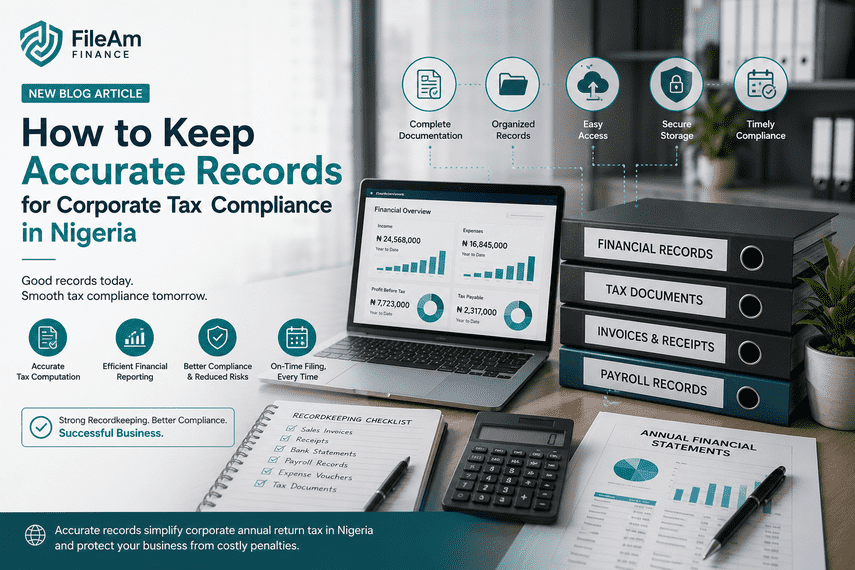
Accurate financial records are the foundation of every successful business. Beyond helping management understand business performance, organized records play a critical role in ensuring compliance with corporate tax obligations. When financial information is incomplete, inconsistent, or difficult to retrieve, preparing annual tax returns becomes more complicated, increasing the likelihood of reporting errors, delayed submissions, and unnecessary compliance challenges.
For businesses managing corporate annual return tax in Nigeria, recordkeeping is not simply an accounting responsibility, it is an essential part of maintaining regulatory compliance. Every financial transaction, from daily sales to supplier payments and payroll expenses, contributes to the information used in preparing annual financial statements and corporate tax returns.
Many tax-related problems do not begin during filing season. Instead, they develop gradually throughout the year as invoices go missing, receipts are misplaced, bank transactions remain unreconciled, or accounting records are updated inconsistently. By the time businesses begin preparing their annual returns, these documentation gaps often create delays, increase administrative work, and make accurate tax computation more difficult.
Effective recordkeeping enables businesses to prepare financial statements efficiently, calculate taxable income accurately, support reported figures during compliance reviews, and respond confidently to regulatory requests. It also helps companies monitor the deadline for corporate tax returns Nigeria more effectively because financial information is already organized and ready for submission.
This guide explains how businesses can build strong recordkeeping systems that simplify corporate annual return tax in Nigeria, improve operational efficiency, reduce compliance risks, and minimize exposure to the penalty for late payment of corporation tax in Nigeria that may arise from delayed or inaccurate tax reporting.
Why Accurate Recordkeeping Matters for Corporate Tax Compliance
Financial records provide the evidence that supports every figure reported in a company’s annual corporate tax return. Without reliable documentation, businesses may struggle to demonstrate the accuracy of their financial statements or justify the tax computations submitted to the relevant authorities.
Good recordkeeping goes beyond storing receipts in folders. It involves establishing a structured system that captures every financial transaction, organizes supporting documentation, and allows information to be retrieved quickly whenever required.
Businesses that maintain organized records throughout the accounting year enjoy several important advantages.
Accurate Tax Computation
Tax calculations rely entirely on accurate financial information. When income and expenses are recorded consistently, businesses can determine taxable profit more confidently and reduce the likelihood of computational errors.
Incomplete or inaccurate records often result in incorrect tax calculations, which may later require amendments or additional clarification during compliance reviews.
Efficient Financial Statement Preparation
Preparing annual financial statements becomes considerably easier when accounting records are maintained continuously.
Rather than spending weeks gathering missing information, businesses can focus on reviewing their financial performance and ensuring that the information presented is complete and accurate.
Better Compliance Verification
Regulatory reviews frequently require supporting documentation for reported financial figures.
Businesses with organized records can respond more efficiently because invoices, receipts, contracts, payroll records, and bank statements are already available in a structured format.
Reduced Compliance Risks
Consistent recordkeeping minimizes the likelihood of missing information, reporting inconsistencies, and documentation gaps that could complicate annual tax filing.
Strong financial records therefore contribute directly to smoother compliance and better corporate governance.
What Records Should Businesses Maintain?
Maintaining complete financial documentation throughout the accounting year is essential for effective corporate tax compliance.
Rather than collecting documents only when filing deadlines approach, businesses should establish processes that capture every important financial transaction as it occurs.
Income and Sales Records
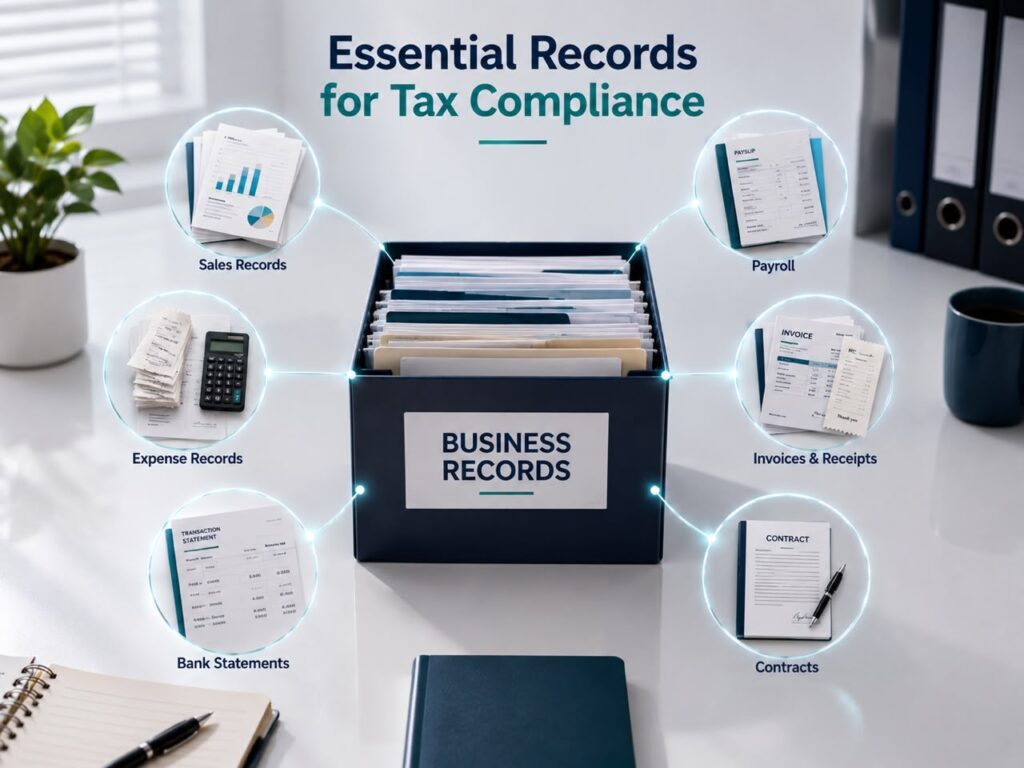
Revenue documentation forms the basis of corporate tax reporting.
Businesses should maintain detailed records of all income-generating activities, including:
- sales invoices;
- customer receipts;
- electronic payment confirmations;
- revenue schedules;
- point-of-sale reports where applicable; and
- customer transaction histories.
Keeping comprehensive sales records helps businesses determine taxable income accurately while supporting reported figures during financial reviews or compliance verification.
Consistent income tracking also enables management to monitor business performance more effectively throughout the accounting year.
Expense Documentation
Business expenses should be documented with the same level of accuracy as revenue.
Proper expense records provide evidence for allowable business costs and contribute to accurate tax computation.
Examples include:
- operational expenses;
- office rent;
- utility payments;
- logistics and transportation costs;
- supplier invoices;
- maintenance expenses;
- professional service fees; and
- other routine business expenditures.
Maintaining supporting documentation for each expense improves financial transparency and reduces the risk of reporting inconsistencies.
Missing expense records may also make it difficult to verify financial information during compliance reviews, highlighting the importance of maintaining complete documentation throughout the year.
Bank Statements and Transaction History
Bank records provide independent evidence of financial activity and support reconciliation between accounting records and actual cash movements.
Businesses should maintain organized copies of:
- monthly bank statements;
- transfer confirmations;
- deposit records;
- electronic payment reports; and
- transaction histories.
Regular reconciliation of accounting records against bank statements helps identify discrepancies early, reducing the likelihood of errors during annual financial reporting.
Accurate bank documentation also strengthens confidence in the overall integrity of the company’s financial records.
Payroll and Salary Records
Companies employing staff should maintain comprehensive payroll documentation throughout the year.
Important payroll records include:
- employee salary schedules;
- payroll summaries;
- statutory deductions;
- pension contribution records;
- employee payment histories; and
- payroll reconciliation reports.
Organized payroll documentation supports accurate financial reporting and contributes to smoother corporate tax compliance by ensuring employment-related financial information is readily available whenever required.
Invoices and Receipts
Invoices and receipts provide the documentary evidence behind almost every financial transaction recorded by a business. They support both income and expense entries, making them some of the most important records for corporate tax compliance.
Every business should maintain organized copies of:
- customer invoices;
- supplier invoices;
- purchase receipts;
- payment receipts;
- credit notes where applicable; and
- electronic transaction confirmations.
These documents help verify that financial transactions were genuine and accurately recorded in the accounting system.
Without supporting invoices and receipts, businesses may struggle to justify reported expenses or revenue during compliance reviews, financial audits, or tax verification exercises. Missing documentation can also increase the time required to prepare annual returns because accountants may need to reconstruct historical transactions from incomplete information.
Maintaining both physical and digital copies of invoices significantly reduces these risks while improving the overall reliability of financial records.
Contracts and Agreements
Business contracts provide valuable context for many financial transactions.
They explain the commercial relationships that generate income or create financial obligations and often support the accounting treatment applied to particular transactions.
Examples include:
- supplier agreements;
- service contracts;
- lease agreements;
- partnership agreements;
- consultancy contracts; and
- long-term customer agreements.
Keeping contracts properly organized allows businesses to demonstrate why particular payments were made and supports the financial records used during corporate tax preparation.
Well-maintained contractual documentation also improves financial transparency and simplifies compliance where regulators request supporting information for significant business transactions.
How Poor Recordkeeping Creates Tax Problems
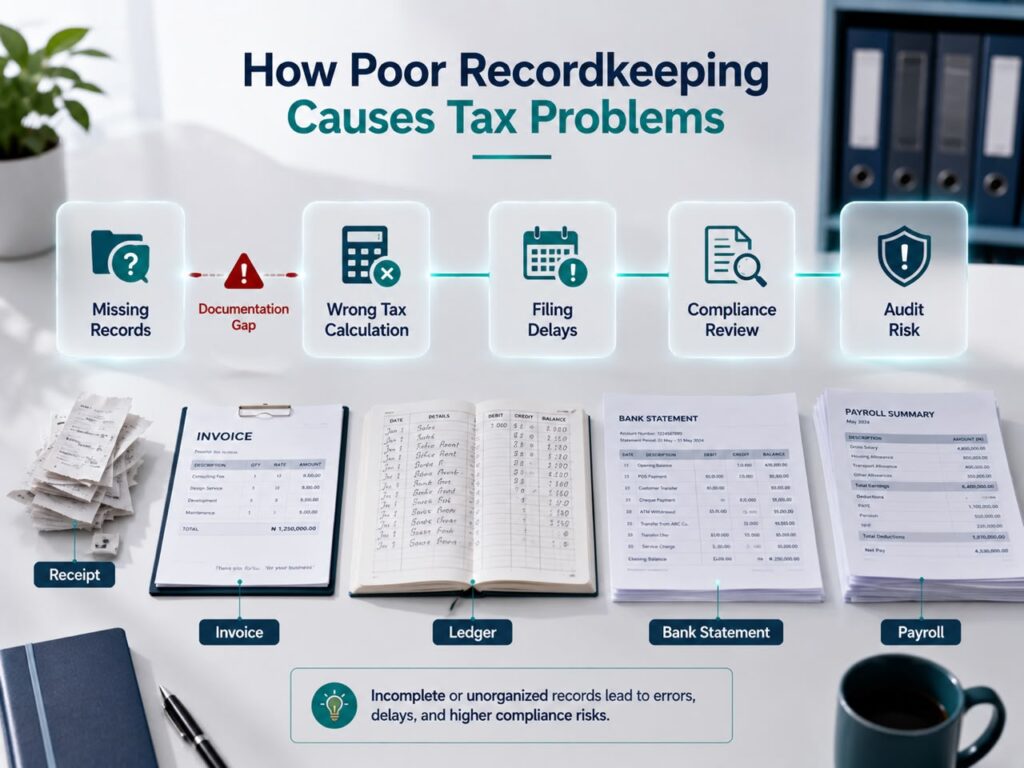
Many businesses mistakenly believe that tax problems begin when annual returns are submitted. In reality, most compliance challenges originate months earlier through inconsistent bookkeeping and inadequate financial documentation.
Poor recordkeeping makes it difficult to prepare accurate financial statements, complete tax computations, and provide supporting evidence for reported figures. As these documentation gaps accumulate throughout the year, the filing process becomes increasingly complex.
Below are some of the most common ways weak recordkeeping affects corporate annual return tax in Nigeria.
Incorrect Tax Computation
Corporate income tax calculations depend on accurate financial information.
When income, expenses, or supporting records are incomplete, businesses may calculate taxable profit incorrectly.
Errors in tax computation can result in:
- inaccurate tax declarations;
- amended returns;
- additional compliance reviews; and
- unnecessary administrative work.
Maintaining complete financial records throughout the accounting year greatly improves the accuracy of tax computations.
Delayed Filing Preparation
Businesses with poorly organized records often spend considerable time searching for missing invoices, reconciling bank transactions, and correcting accounting inconsistencies before they can even begin preparing their annual returns.
These delays become particularly problematic as the date for corporate tax returns in Nigeria approaches.
Instead of focusing on reviewing financial statements and confirming tax computations, management may be forced to reconstruct months of missing financial information.
Preparing records continuously throughout the year allows businesses to avoid these last-minute pressures and complete tax filing more efficiently.
Missing Supporting Documentation
Every figure reported in a corporate tax return should be supported by appropriate financial documentation.
Where invoices, receipts, contracts, or payroll records cannot be located, businesses may find it difficult to demonstrate the accuracy of reported transactions.
Strong documentation improves confidence in financial reporting and reduces complications during compliance verification or regulatory reviews.
Increased Audit Risk
Although maintaining organized records does not eliminate the possibility of future reviews, inconsistent or incomplete financial documentation may increase the likelihood of additional compliance scrutiny.
Businesses with reliable accounting records are generally better prepared to respond to requests for supporting information because relevant documents can be retrieved quickly and efficiently.
Developing consistent documentation practices therefore strengthens both operational efficiency and overall corporate governance.
Best Practices for Keeping Accurate Tax Records
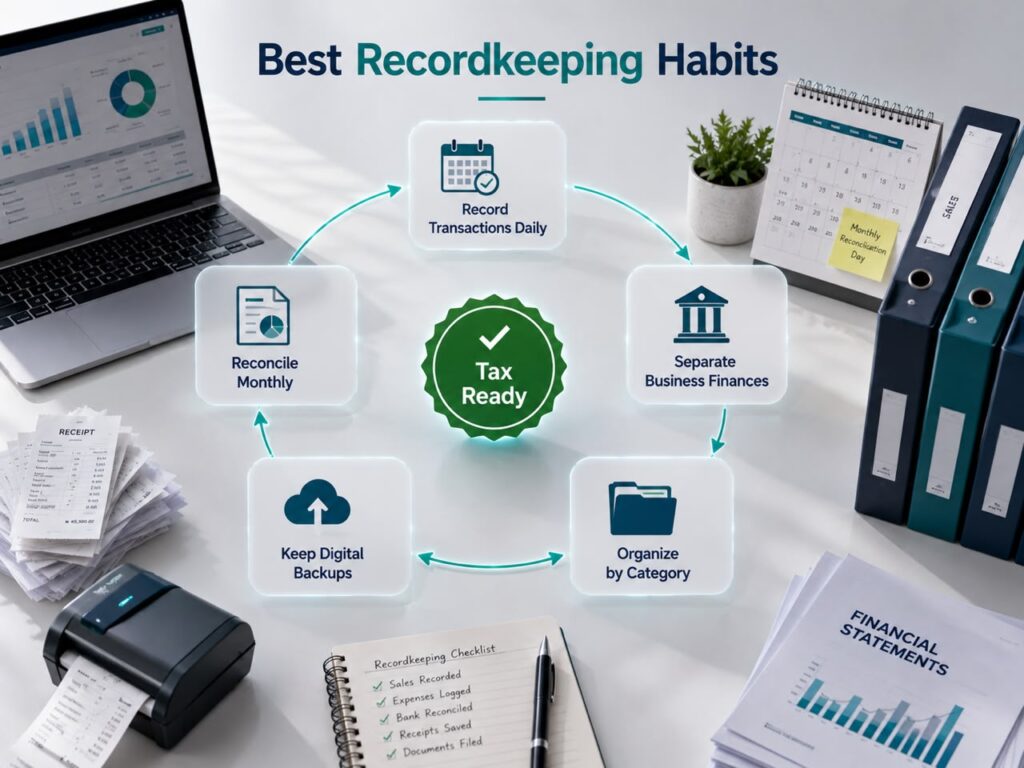
Effective recordkeeping does not require complicated accounting systems. What matters most is maintaining consistency throughout the accounting year.
Record Transactions Immediately
Financial transactions should be recorded as soon as they occur.
Waiting several weeks, or even months, before updating accounting records increases the likelihood of forgotten transactions, missing receipts, and inaccurate financial information.
Timely recording ensures that financial records remain current and reduces the workload associated with year-end reconciliation.
Separate Personal and Business Finances
One of the most common bookkeeping mistakes made by small businesses is mixing personal and business transactions.
Maintaining dedicated business bank accounts and recording business expenses separately improves financial clarity, simplifies bookkeeping, and reduces confusion during annual tax preparation.
This practice also strengthens the credibility of financial statements by ensuring that reported business transactions accurately reflect company operations.
Organize Records by Category and Date
An effective filing system should make documents easy to locate whenever they are required.
Businesses should organize financial records by category, such as:
- income;
- expenses;
- payroll;
- bank records;
- invoices;
- contracts; and
- tax documents.
Within each category, arranging documents chronologically makes retrieval significantly faster during financial reporting and annual tax preparation.
Maintaining this structure throughout the year also helps businesses monitor the date for corporate tax returns in Nigeria, because the required documentation is already organized before filing begins.
Maintain Digital Copies and Secure Backups
Paper records remain useful, but relying exclusively on physical documentation exposes businesses to unnecessary risks.
Documents may become damaged, misplaced, or inaccessible when urgently needed.
Maintaining secure digital copies provides several advantages:
- improved accessibility;
- faster document retrieval;
- reduced risk of loss;
- long-term preservation; and
- easier sharing with accountants and compliance professionals.
Digital recordkeeping also supports remote work and allows businesses to prepare financial information more efficiently throughout the accounting year.
Reconcile Records Regularly
Monthly reconciliation is one of the simplest ways to improve financial accuracy.
Comparing accounting records against bank statements allows businesses to identify:
- missing transactions;
- duplicate entries;
- incorrect postings; and
- unexplained financial differences.
Resolving discrepancies each month prevents small errors from accumulating into larger compliance problems at year-end.
Regular reconciliation also helps businesses prepare more confidently for annual filing while reducing the possibility of delays that could ultimately contribute to the penalty for late payment of corporation tax in Nigeria if unresolved reporting issues postpone accurate tax assessment and settlement.
How Long Should Businesses Keep Financial Records in Nigeria?
Keeping accurate records is only part of effective corporate tax compliance. Businesses must also retain those records for an appropriate period so they are available whenever needed for verification, reassessment, or compliance reviews.
Historical financial records provide valuable evidence that supports previously submitted tax returns and helps businesses respond to regulatory requests efficiently. Even after an annual return has been filed, supporting documents may still be required during future reviews or when questions arise regarding earlier reporting periods.
Businesses should therefore establish a document retention policy that ensures important financial records remain secure, organized, and easily retrievable.
Examples of records that should be preserved include:
- financial statements;
- bank statements;
- invoices and receipts;
- payroll records;
- contracts and agreements;
- tax computations; and
- previous corporate tax returns.
Long-term record retention also improves continuity between accounting years, making future financial reporting more accurate and efficient.
Common Recordkeeping Mistakes Businesses Make
Many corporate tax compliance issues can be traced back to avoidable documentation mistakes rather than complex tax regulations.
Understanding these common errors helps businesses strengthen their financial management processes and improve the quality of information used in preparing corporate annual returns in Nigeria.
Losing Receipts and Invoices
Invoices and receipts provide the evidence needed to support financial transactions.
When these documents are misplaced or discarded, businesses may struggle to verify expenses or revenue during annual tax preparation.
Developing a consistent filing system for both physical and electronic documents significantly reduces this risk.
Waiting Until Year-End to Organize Records
One of the most common causes of stressful tax filing is postponing bookkeeping until the end of the accounting year.
Attempting to organize months of financial transactions immediately before the date for corporate tax returns Nigeria increases the likelihood of missing documents, reporting errors, and delayed submissions.
Maintaining records continuously throughout the year allows businesses to prepare annual returns with greater confidence and significantly less administrative pressure.
Using Inconsistent Bookkeeping Methods
Changing accounting procedures frequently can create confusion and reduce the reliability of financial information.
Businesses should adopt standardized bookkeeping practices that are applied consistently throughout the accounting year.
Consistency improves financial reporting, simplifies reconciliation, and makes annual tax preparation considerably more efficient.
Having No Backup Documentation System
Relying on a single storage method exposes businesses to unnecessary risk.
Paper documents may be damaged, while electronic files can be lost if they are not backed up properly.
Maintaining secure digital backups alongside original records provides additional protection against accidental loss and improves accessibility whenever documentation is required.
Digital Recordkeeping vs. Manual Recordkeeping
Many Nigerian businesses continue to rely primarily on paper-based bookkeeping systems. Although manual recordkeeping can still be effective when managed carefully, digital financial management systems provide significant operational advantages.
Advantages of Digital Recordkeeping
Digital systems improve financial management by making records easier to organize, search, and retrieve.
Businesses using structured digital platforms often benefit from:
- centralized financial records;
- faster document retrieval;
- improved collaboration with accountants;
- secure backups;
- reduced risk of document loss; and
- more efficient long-term storage.
Digital recordkeeping also simplifies annual tax preparation because financial information is already organized before filing begins.
Risks of Paper-Only Systems
Businesses relying exclusively on physical documentation may encounter several practical challenges.
Paper records can become:
- misplaced;
- damaged;
- difficult to retrieve quickly; or
- incomplete due to missing documents.
These problems become particularly noticeable during annual tax preparation when businesses must gather large volumes of supporting documentation within limited timeframes.
Adopting digital systems alongside traditional recordkeeping can significantly reduce these operational risks while improving overall compliance efficiency.
Why Structured Financial Platforms Improve Compliance
Modern financial management platforms allow businesses to centralize accounting information in one secure environment instead of maintaining separate spreadsheets, paper files, and disconnected software.
A structured platform helps businesses:
- organize financial documents consistently;
- maintain complete accounting records;
- prepare financial statements more efficiently;
- support accurate tax computations; and
- simplify annual corporate tax filing.
Rather than spending valuable time searching for documents during filing season, businesses can focus on reviewing financial information and ensuring that returns are accurate before submission.
How Accurate Records Improve Tax Filing Efficiency
Accurate recordkeeping does more than satisfy compliance requirements; it makes the entire tax filing process more efficient.
Businesses with organized financial information generally experience:
Faster Financial Statement Preparation
Financial data is already categorized and readily available, reducing the time needed to prepare year-end reports.
Easier Tax Computation
Reliable accounting records improve the accuracy of taxable income calculations and reduce the likelihood of reporting errors.
Reduced Filing Stress
When documentation has been maintained throughout the year, businesses avoid the last-minute rush that often accompanies annual filing.
Greater Compliance Confidence
Companies with complete financial records are better prepared to file on time, respond to compliance queries, and avoid unnecessary delays that could contribute to the penalty for late payment of corporation tax in Nigeria, where outstanding tax liabilities remain unresolved.
How FileAm Helps Businesses Maintain Accurate Tax Records
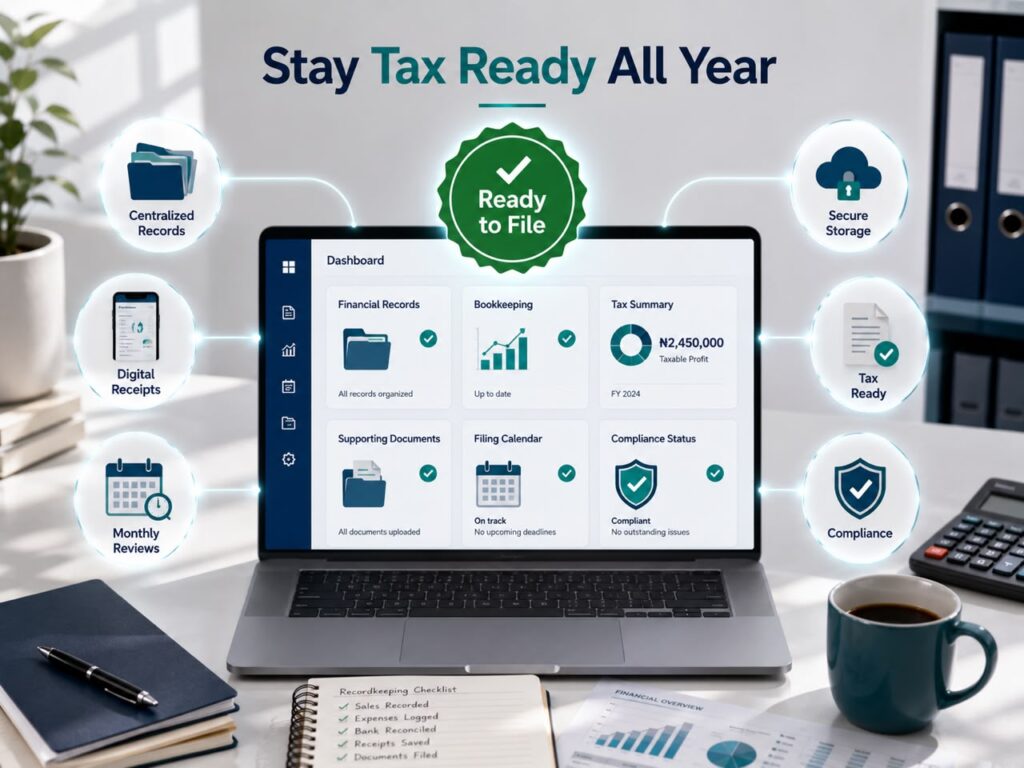
One of the biggest obstacles to successful tax compliance is fragmented financial information. Businesses often keep invoices in one location, bank statements in another, payroll records in separate files, and receipts in physical folders, making year-end preparation unnecessarily difficult.
FileAm helps solve this challenge by providing a structured environment where businesses can organize financial records throughout the year instead of waiting until filing season.
With FileAm, businesses can:
- centralize financial documents in one location;
- improve bookkeeping consistency;
- simplify financial statement preparation;
- reduce missing documentation;
- support accurate corporate annual return tax filings in Nigeria; and
- remain prepared for future compliance obligations.
By maintaining organized financial information year-round, businesses can spend less time searching for records and more time focusing on growth, operational efficiency, and strategic decision-making.
Conclusion
As the original article emphasizes, successful corporate tax compliance begins with accurate and well-organized financial records. Businesses that maintain complete documentation throughout the year are better equipped to prepare reliable financial statements, calculate taxable income correctly, and meet their reporting obligations with confidence.
For businesses managing corporate annual return tax in Nigeria, strong recordkeeping is not simply an administrative task, it is a strategic investment in long-term compliance, financial transparency, and operational efficiency. Maintaining organized records also makes it easier to monitor the deadline for corporate tax returns in Nigeria, reducing the likelihood of rushed filings and documentation gaps.
Finally, businesses should recognize that incomplete records can contribute to filing delays, inaccurate tax computations, and additional compliance challenges that may ultimately increase exposure to the penalty for late payment of corporation tax in Nigeria, where tax liabilities are not assessed or settled promptly.
Good recordkeeping, supported by disciplined financial management and modern digital tools such as FileAm, transforms annual tax filing from a stressful exercise into a structured and efficient business process.
Leave a Reply