
Submitting your corporate tax return is a significant milestone in meeting your company’s tax obligations, but it does not necessarily mark the end of the compliance process. Many businesses assume that once a corporate tax return has been submitted to the Federal Inland Revenue Service (FIRS), any mistakes discovered afterward are permanent and cannot be corrected. This misconception often causes unnecessary concern, especially when accounting errors, omitted information, or incorrect tax computations come to light after filing.
In reality, errors can occur even in well-managed organizations. Financial records may be updated after submission, supporting documents may reveal discrepancies, or simple data entry mistakes may only become apparent during an internal review. What matters most is not whether an error occurred, but how quickly and responsibly it is addressed. Taking prompt action helps businesses maintain accurate tax records and demonstrates a commitment to compliance.
Understanding the process for correcting errors is an important part of managing corporate annual return tax in Nigeria. Whether the issue involves an incorrect financial figure, a missing deduction, or an error in the reporting period, businesses should follow the appropriate procedures to amend their tax position rather than ignoring the problem.
Timely corrections are also important because they may affect the company’s overall compliance status. Businesses that identify and resolve mistakes early are generally better positioned to avoid unnecessary disputes, additional assessments, and administrative delays. Conversely, leaving known errors unresolved may complicate future filings, affect the issuance of Tax Clearance Certificates, and expose the business to avoidable regulatory scrutiny.
It is equally important to understand that the correction process is different from filing a completely new return. Instead, businesses generally work through established amendment or reassessment procedures, depending on the nature and significance of the error. Knowing when and how to follow these procedures can save time, reduce administrative burdens, and ensure that company records remain accurate.
This guide explains the types of errors that can be corrected after submission, the steps involved in making amendments, when reassessment may be required, and the best practices businesses should adopt to minimize filing mistakes in future reporting cycles. While prevention remains the best approach, understanding how corrections work provides an additional layer of confidence for businesses managing corporate annual return tax in Nigeria.
Understanding Corporate Annual Return Tax in Nigeria and Why Accuracy Matters
Accurate tax reporting begins long before a company submits its annual corporate tax return. Every registered business is expected to maintain complete financial records throughout the accounting year and use those records to prepare a truthful representation of its financial performance. This information forms the basis of the corporate annual tax return in Nigeria, making accuracy one of the most important aspects of tax compliance.
Corporate tax returns are more than a statutory filing requirement. They provide tax authorities with information used to assess a company’s taxable income and determine whether the correct amount of corporate income tax has been declared. Because these returns influence tax assessments, financial reporting, and future compliance activities, even relatively small mistakes can have wider implications if left uncorrected.
Errors do not always indicate negligence. Many businesses discover issues only after completing internal audits, reconciling financial statements, or reviewing newly available documentation. For example, an expense may have been classified incorrectly, a revenue figure may have been duplicated, or an allowable deduction may have been omitted during the original preparation of the return.
Modern accounting systems have reduced the likelihood of manual calculation errors, but they cannot eliminate every possibility. Changes made to financial statements after filing, incomplete supporting documentation, or misunderstandings during tax computation can still result in inaccuracies that require formal correction.
Maintaining accurate tax records benefits businesses in several important ways. It supports better financial planning, simplifies future reporting obligations, improves credibility with financial institutions, and strengthens relationships with regulatory authorities. Accurate reporting also reduces the likelihood of compliance queries and makes future audits easier to manage.
Most importantly, businesses should view tax compliance as an ongoing process rather than a single annual event. Filing a return represents one stage of a broader compliance cycle that includes maintaining records, monitoring financial transactions, reviewing tax positions, and correcting genuine mistakes whenever they are identified.
By approaching compliance with this mindset, organizations create stronger financial management systems and reduce the risk of recurring filing errors in future years.
Can You Correct a Corporate Tax Return After Submission?

The simple answer is yes. A corporate tax return can be corrected after submission where an error is identified, corrected follows the appropriate procedures established by the relevant tax authority. The existence of an error does not automatically invalidate an entire tax return, nor does it necessarily require a company to begin the filing process from the beginning.
Instead, businesses are expected to assess the nature of the mistake, determine its impact on the tax return, and pursue the appropriate amendment or reassessment process where necessary. The objective is to ensure that the company’s tax records accurately reflect its true financial position rather than allowing known inaccuracies to remain on record.
Whether a correction is required often depends on several factors, including:
- the type of error that occurred;
- whether the mistake affects taxable income;
- whether the correction changes the company’s tax liability;
- the significance of the error; and
- the supporting documentation available to justify the amendment.
Some corrections involve relatively minor issues, such as typographical mistakes or incorrect reference numbers that do not affect the amount of tax payable. These types of errors are generally simpler to address because they do not alter the underlying tax computation.
Other situations are more significant. If a business discovers that taxable income was understated, allowable deductions were omitted, or financial figures were reported incorrectly, the correction may affect the overall tax assessment. In such cases, additional documentation and a more structured review process may be required before the amendment is accepted.
An important principle for every business is to act promptly. Delaying corrective action after discovering an error may create unnecessary complications, particularly if future tax filings rely on inaccurate information from earlier returns. Correcting mistakes early helps maintain consistency across financial records and reduces the likelihood of cumulative reporting problems over time.
Businesses should also avoid making informal adjustments outside the appropriate compliance process. Simply changing internal accounting records without ensuring that official tax records are updated may create inconsistencies that become more difficult to resolve during future reviews or audits.
Ultimately, correcting a corporate tax return is not a sign of failure. On the contrary, it demonstrates responsible financial governance and a willingness to maintain accurate records. Companies that address mistakes transparently and through the proper channels reinforce their commitment to sound compliance practices and long-term regulatory accountability.
Types of Errors That Can Be Corrected After Filing
Not every error discovered after submitting a corporate tax return has the same impact on a company’s tax position. Some mistakes are purely administrative and can be corrected with minimal adjustments, while others may affect taxable income, tax liability, or the accuracy of financial reporting.
Understanding the type of error is the first step toward determining the most appropriate correction process. Before initiating any amendment, businesses should carefully review the submitted return alongside supporting financial records to determine the nature and extent of the mistake.
The following are some of the most common errors that businesses identify after filing their corporate tax returns.
Financial Statement Errors
Financial statement errors occur when the figures reported in the corporate tax return do not accurately reflect the company’s audited or final financial statements.
Examples include:
- Incorrect revenue figures.
- Misclassified operating expenses.
- Omitted liabilities.
- Incorrect asset values.
- Errors in profit before tax calculations.
Because financial statements form the basis of corporate annual return tax in Nigeria, inaccuracies at this level may affect every subsequent stage of the tax computation process.
In many cases, these errors arise because adjustments were made to the financial statements after the tax return had already been prepared or submitted. Businesses should therefore ensure that the version of the financial statements used for tax filing is the final approved version.
Where discrepancies are discovered after submission, they should be documented clearly before any amendment is initiated.
Tax Computation Errors
Tax computation errors involve mistakes made while converting accounting profit into taxable profit.
Although financial statements provide the company’s accounting results, tax legislation may require certain adjustments before determining taxable income.
Typical computation errors include:
- mathematical mistakes;
- omission of required adjustments;
- incorrect capital allowance calculations;
- failure to exclude non-taxable income where applicable; and
- inaccurate treatment of deductible expenses.
These errors can either increase or decrease the company’s reported tax liability.
For this reason, businesses should carefully review every stage of the tax computation before requesting an amendment. A corrected computation should reconcile fully with the supporting financial records to avoid introducing additional inconsistencies.
Missing or Incorrect Deductions
Another common issue involves deductions that were omitted, duplicated, or applied incorrectly during the preparation of the original return.
For example, a business may later discover that:
- qualifying expenses were overlooked;
- allowable deductions were calculated incorrectly;
- supporting documentation was incomplete during filing; or
- certain adjustments were applied to the wrong accounting period.
Correcting these issues helps ensure that the company’s taxable income accurately reflects its financial position.
However, every adjustment should be supported by appropriate documentation. Businesses should avoid making unsupported changes simply to reduce tax liability, as doing so may create further compliance concerns during future reviews.
Data Entry Errors
Not every correction involves complex tax calculations.
Some of the most common post-submission amendments arise from simple data entry mistakes.
Examples include:
- incorrect company registration numbers;
- typographical errors;
- misplaced decimal points;
- transposed numerical values;
- incorrect dates; and
- accidental duplication of figures.
Although these mistakes may appear minor, they can sometimes create inconsistencies between different sections of the return or affect automated validation systems.
Businesses should therefore review every section of the submitted return carefully before assuming that a data entry mistake is insignificant.
Incorrect Financial Year or Reporting Period
Corporate income tax returns are prepared for a specific accounting period.
If the wrong financial year is selected or figures from different reporting periods are mixed, the accuracy of the entire return may be compromised.
Examples include:
- reporting twelve months of income using the wrong accounting year;
- including transactions from the following financial year;
- excluding transactions belonging to the reporting period; or
- preparing the return using an outdated financial reporting schedule.
These errors may affect both tax computation and future compliance records.
Since the date for corporate tax returns in Nigeria is linked directly to the company’s accounting year, ensuring that the correct reporting period is used is essential for maintaining accurate tax records.
Supporting Documentation Errors
Even where tax computations are accurate, incomplete supporting documentation may still require corrective action.
Examples include:
- missing financial schedules;
- incomplete audit reports;
- omitted supporting statements;
- inconsistencies between attached documents; and
- incorrect references to supporting schedules.
Maintaining complete documentation improves transparency and allows tax authorities to understand the basis of the reported figures.
Businesses should therefore treat supporting documents as an integral part of the filing process rather than an administrative afterthought.
Ultimately, identifying the exact type of error determines the most appropriate correction process and helps ensure that amendments address the underlying issue rather than merely correcting the visible symptom.
Step-by-Step Approach to Correcting Corporate Tax Return Errors
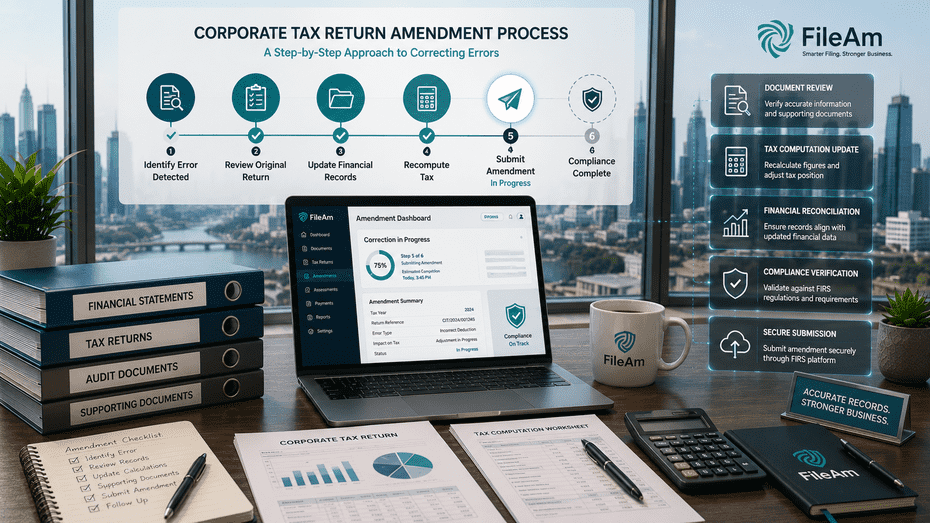
Correcting a corporate tax return should be approached systematically. Rather than attempting to make isolated adjustments, businesses should follow a structured process that ensures every correction is properly documented, accurately calculated, and supported by reliable financial records.
A disciplined approach not only improves the quality of the amendment but also reduces the likelihood of creating additional inconsistencies during the correction process.
Step 1: Identify and Document the Error
The first step is to determine precisely what went wrong.
Businesses should clearly establish:
- the nature of the error;
- where the error occurred;
- why it occurred;
- whether it affects taxable income; and
- whether other sections of the return are also affected.
Simply noticing that “something looks wrong” is not sufficient.
A documented explanation helps management understand the scope of the issue and provides a clear basis for preparing the necessary correction.
Where possible, supporting evidence should also be assembled at this stage, including revised financial records, accounting schedules, and relevant source documents.
Step 2: Review the Original Submitted Return
Before making any changes, businesses should carefully examine the return that was originally submitted.
This review should include:
- the completed tax return;
- supporting financial statements;
- tax computation schedules;
- audit documentation; and
- working papers used during the original preparation process.
Comparing these documents with updated financial records helps identify whether the error is isolated or whether it affects multiple sections of the return.
A thorough review also reduces the likelihood of overlooking related issues that may require correction.
Step 3: Prepare Corrected Financial Records
Once the error has been identified, businesses should update the relevant financial information before recalculating their tax position.
This may involve:
- revising accounting entries;
- updating supporting schedules;
- correcting classifications;
- reconciling affected accounts; and
- ensuring consistency across all financial reports.
Preparing corrected records before recalculating taxes helps ensure that the amendment reflects the company’s true financial position rather than addressing only one isolated figure.
Consistency is essential.
Every supporting document should align with the revised financial information to avoid creating conflicting records.
Step 4: Recompute the Tax Position
After updating the financial records, the company should prepare a revised tax computation based on the corrected information.
This process typically involves:
- recalculating taxable income;
- reviewing allowable deductions;
- updating capital allowance schedules;
- confirming revised tax liability; and
- verifying that all supporting computations are internally consistent.
This stage determines whether the correction results in:
- additional tax payable;
- reduced tax liability;
- tax credit; or
- no change to the amount of tax due.
Businesses should review these calculations carefully before proceeding with any amendment.
Step 5: Submit the Amendment Through the Appropriate Process
Once the corrected information has been prepared and reviewed, the business should initiate the appropriate amendment or reassessment procedure through the relevant tax authority.
The objective is not to submit a completely new return but to formally update the original filing using the prescribed process.
Supporting documentation should accompany the amendment where necessary to demonstrate the basis for the revised figures.
Maintaining complete records of all correspondence and submitted documents is also advisable for future reference.
Step 6: Await Review or Reassessment
Following submission, the relevant tax authority reviews the amendment and determines whether additional clarification, a revised assessment, or further documentation is required.
Depending on the nature of the correction, the review process may result in:
- confirmation of the revised figures;
- issuance of an updated assessment;
- adjustment of the company’s tax liability; or
- requests for additional supporting information.
Businesses should respond promptly to any requests during this stage to facilitate timely resolution.
Once the review has been completed, the corrected information becomes part of the company’s official tax record and should be retained together with the original filing documentation for future reference.
When Should You Request an Amendment vs. a Reassessment?
Although businesses often use the terms amendment and reassessment interchangeably, they do not always refer to the same process. Understanding the distinction helps businesses choose the appropriate approach when correcting errors in a previously submitted corporate tax return.
The right course of action generally depends on the nature of the error and whether it materially changes the company’s tax position.
Minor Corrections
Minor corrections typically involve errors that do not significantly affect the amount of tax payable. These may include:
- Typographical errors.
- Incorrect company details.
- Minor data entry mistakes.
- Incorrect reference numbers.
- Formatting inconsistencies.
While these errors should still be corrected to maintain accurate records, they usually require less extensive review because they do not substantially alter the company’s reported tax liability.
Material Corrections
Material corrections involve errors that directly affect taxable income or the amount of tax payable.
Examples include:
- Significant revenue adjustments.
- Incorrect expense recognition.
- Omitted allowable deductions.
- Incorrect capital allowance calculations.
- Changes to taxable profit.
Because these corrections alter the company’s financial position, additional supporting documentation and a more detailed review process are often required before the amendment can be finalized.
Reassessment Cases
Some corrections are significant enough that they require a formal reassessment of the original tax position.
This may occur where:
- revised financial information substantially changes taxable income;
- the original assessment no longer reflects the company’s true financial position; or
- additional tax becomes payable after correcting the return.
Rather than viewing reassessment as a penalty, businesses should see it as a structured mechanism for ensuring that official tax records accurately reflect the corrected financial information.
Choosing the appropriate correction pathway helps reduce unnecessary delays and ensures that amendments are processed more efficiently.
Impact of Correcting Errors on Tax Liability
Correcting a corporate tax return does not always produce the same financial outcome. The effect depends entirely on the nature of the error and how it influences the company’s taxable income.
Understanding these possible outcomes helps businesses prepare for the implications of submitting an amendment.
Additional Tax Payable
Where the correction reveals that taxable income was previously understated or allowable adjustments were calculated incorrectly, the revised computation may result in additional tax becoming payable.
In these situations, businesses should settle any outstanding liability promptly to maintain compliance and reduce the likelihood of further administrative consequences.
Reduced Tax Liability or Tax Credit
Corrections can also work in the company’s favour.
If the original return overstated taxable income or omitted legitimate deductions, the revised computation may reduce the company’s tax liability or result in a credit, depending on the applicable administrative process.
The key objective of every amendment is accuracy, not increasing or decreasing tax arbitrarily.
Neutral Adjustments
Not every correction changes the amount of tax payable.
Some amendments simply improve the accuracy of financial reporting by correcting administrative information, supporting schedules, or reporting inconsistencies without affecting the underlying tax computation.
Although these adjustments may appear minor, they contribute to stronger compliance records and improve consistency across future filings.
How the Date for Corporate Tax Returns Nigeria Affects Post-Submission Corrections
Many businesses focus only on submitting their annual corporate tax return before the filing deadline. However, the period immediately after submission is equally important, particularly when errors are discovered.
The date for corporate tax returns in Nigeria is determined by a company’s financial year-end rather than a single nationwide filing date. Because each business follows its own compliance timeline, corrections should be initiated as soon as inaccuracies are identified.
Waiting until the next filing cycle to address known errors may create inconsistencies between historical records and future returns. In some cases, unresolved discrepancies can complicate future tax computations, internal audits, and regulatory reviews.
For this reason, businesses should establish internal post-filing review procedures shortly after every submission. Reviewing financial statements, tax computations, and supporting schedules while records are still readily available makes it easier to identify and resolve mistakes before they affect subsequent reporting periods.
A proactive approach ensures that the company’s compliance history remains accurate and demonstrates a commitment to responsible financial governance.
What Happens If Errors Are Not Corrected?
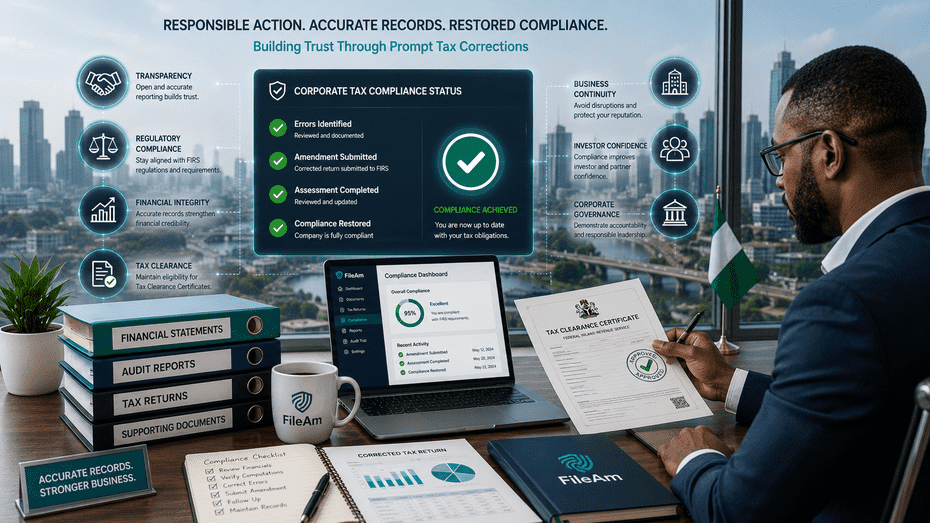
Some businesses assume that minor errors are unlikely to attract attention and therefore choose not to correct them. While every situation is different, allowing known inaccuracies to remain unresolved may create avoidable compliance challenges over time.
The consequences extend beyond the immediate tax return and can affect future reporting, regulatory interactions, and the company’s overall financial credibility.
Compliance Concerns
Inconsistent financial information may raise questions during future compliance reviews, particularly where figures differ across multiple reporting periods.
Maintaining accurate records helps ensure continuity between annual filings and reduces the likelihood of discrepancies.
Increased Audit Exposure
Although correcting an error does not automatically trigger an audit, leaving significant inaccuracies unresolved may increase the need for further clarification during future reviews.
Accurate and transparent amendments generally demonstrate responsible compliance rather than regulatory avoidance.
Tax Clearance Certificate Delays
Many businesses require a Tax Clearance Certificate for government contracts, financing arrangements, investment opportunities, and various corporate transactions.
Unresolved errors in previously submitted tax returns may complicate or delay compliance processes that rely on accurate historical tax records.
Long-Term Record Inconsistencies
Corporate tax returns form part of a company’s long-term financial history.
If an error remains uncorrected, future returns may inadvertently rely on inaccurate information, making subsequent corrections more complicated and time-consuming.
Addressing issues promptly helps preserve the integrity of the company’s financial reporting system.
Can Errors Lead to a Penalty for Late Payment of Corporation Tax in Nigeria?
Businesses often ask whether correcting an error automatically results in penalties.
The answer depends on the nature of the correction.
If an amendment reveals that additional corporate income tax should have been paid, businesses should resolve the outstanding liability as quickly as possible. Delays in settling additional tax obligations may expose the company to the penalty for late payment of corporation tax in Nigeria, together with any applicable interest under relevant tax laws.
By contrast, amendments that simply correct administrative information or reporting inconsistencies without changing the amount of tax payable may not have the same financial implications.
The most effective way to reduce the risk of penalties is to:
- maintain accurate bookkeeping throughout the year;
- review returns thoroughly before submission;
- identify errors promptly;
- initiate corrections without unnecessary delay; and
- maintain complete supporting documentation.
Proactive compliance not only reduces financial risk but also strengthens the company’s relationship with tax authorities.
Common Mistakes Businesses Make When Correcting Returns
Even after discovering an error, businesses sometimes introduce new problems by following informal or incomplete correction processes.
Common mistakes include:
Skipping Formal Procedures
Attempting to adjust internal accounting records without updating official tax records may create inconsistencies that complicate future reporting.
Submitting Incomplete Documentation
Every correction should be supported by clear financial records and relevant schedules. Missing documentation may delay the review process.
Delaying Corrections
Waiting several months before addressing known inaccuracies often makes corrections more complicated because additional reporting periods may already have been completed.
Incorrect Recalculation
Revising one figure without reviewing the entire tax computation can introduce new inconsistencies.
Businesses should ensure that every amendment reflects the complete financial impact of the correction rather than adjusting isolated figures.
Best Practices for Handling Post-Submission Corrections
Businesses can significantly reduce compliance challenges by adopting structured correction procedures.
Some recommended practices include:
- Act immediately after discovering an error.
- Maintain complete financial documentation.
- Ensure every amendment is internally consistent.
- Review revised computations before submission.
- Keep records of all correspondence relating to the amendment.
- Conduct internal compliance reviews after every filing season.
- Use reliable accounting systems to reduce manual errors.
- Seek professional tax advice where corrections are complex.
Developing these habits improves both current compliance and future tax reporting.
How FileAm Helps Reduce Filing Errors
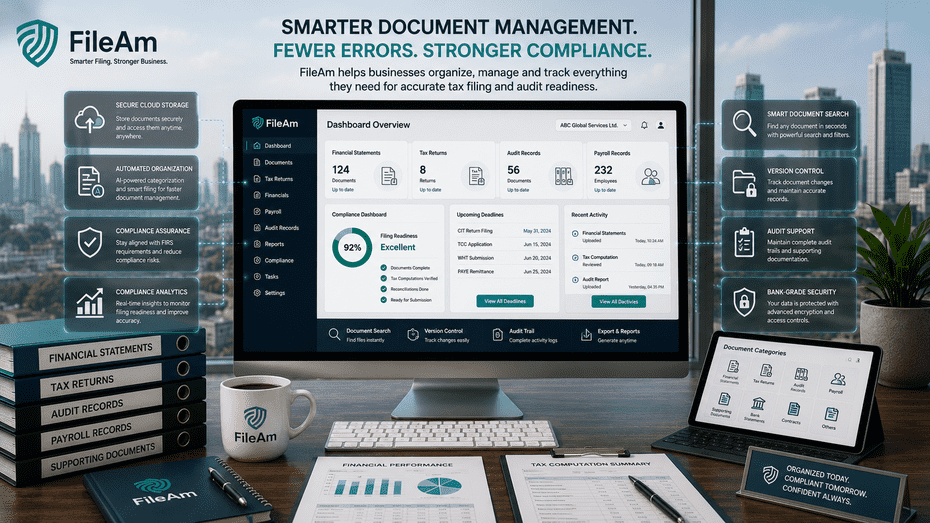
Many post-submission amendments occur because financial records were incomplete, disorganized, or inconsistent before the tax return was prepared.
FileAm helps businesses reduce these risks by supporting better financial organization throughout the year.
Using structured digital records enables businesses to:
- maintain organized financial information;
- improve bookkeeping consistency;
- simplify document retrieval;
- support more accurate tax computations;
- reduce manual data entry errors; and
- minimize the likelihood of post-submission amendments.
When financial records remain accurate throughout the accounting year, preparing corporate annual return tax in Nigeria becomes significantly more efficient and less stressful.
Frequently Asked Questions
Can a corporate tax return be corrected after submission?
Yes. Where an error is identified, businesses can follow the appropriate amendment or reassessment procedures to correct the original filing.
What types of errors can be corrected?
Common examples include financial statement errors, tax computation mistakes, incorrect reporting periods, data entry errors, omitted deductions, and supporting documentation issues.
What is the date for corporate tax returns in Nigeria?
The date for corporate tax returns in Nigeria generally depends on the company’s financial year-end. Businesses should maintain an internal compliance calendar based on their own reporting cycle.
Can correcting a return reduce my tax liability?
Yes. If the correction identifies an overstatement of taxable income or an omitted allowable deduction, the revised computation may reduce the company’s tax liability, depending on the applicable administrative process.
Can correcting an error help avoid the penalty for late payment of corporation tax in Nigeria?
Where a correction identifies additional tax payable, resolving the matter promptly can help businesses minimize further compliance consequences and avoid unnecessary delays in meeting their obligations.
Conclusion
Discovering an error after submitting a corporate tax return does not mean a business has failed in its compliance obligations. What matters is how promptly and responsibly the issue is addressed. The process for correcting post-submission errors exists to ensure that tax records accurately reflect a company’s financial position and support fair tax administration.
Businesses managing corporate annual return tax in Nigeria should treat post-filing reviews as an essential part of their annual compliance process. By identifying inaccuracies early, maintaining organized financial records, understanding the date for corporate tax returns Nigeria, and taking timely corrective action where necessary, companies can strengthen their compliance practices and reduce the risk of future complications.
Most importantly, organizations should remember that unresolved errors may have broader implications, particularly where they affect tax liabilities. Acting promptly can help minimize exposure to the penalty for late payment of corporation tax in Nigeria, maintain accurate compliance records, and support the long-term financial integrity of the business.
Leave a Reply