
Late filing of Company Income Tax (CIT) returns can expose businesses in Nigeria to financial penalties, interest on unpaid taxes, regulatory scrutiny, and unnecessary compliance challenges. Whether you operate a small startup, a growing SME, or a large corporation, understanding your tax obligations is essential for protecting your business and maintaining good standing with the relevant tax authorities.
As Nigeria continues modernizing its tax administration in 2026 through expanded digital filing systems and improved compliance monitoring, businesses are expected to submit accurate tax returns within statutory deadlines. Missing these deadlines can result in avoidable costs that may affect cash flow and business operations.
This comprehensive guide explains everything every Nigerian business should know about Company Income Tax Late Filing Penalties in Nigeria (2026), including filing deadlines, applicable penalties, common filing mistakes, practical compliance tips, and how digital solutions like FileAm simplify company tax filing.
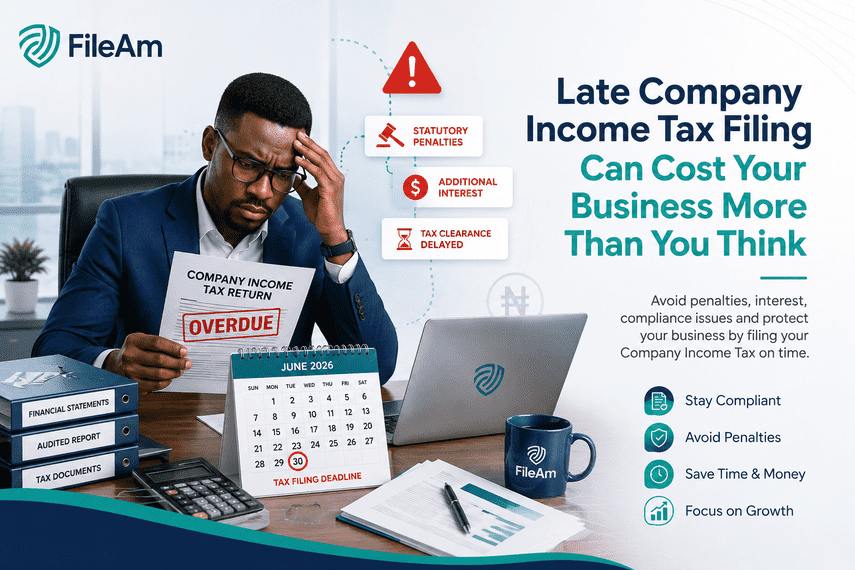
What is Company Income Tax (CIT) in Nigeria?
Company Income Tax (CIT) is a tax imposed on the taxable profits of companies operating in Nigeria. It represents one of the major sources of government revenue and applies to both resident companies and certain non-resident companies carrying on business within Nigeria, subject to applicable tax laws.
Businesses are generally required to:
- Prepare annual financial statements.
- Calculate taxable profits.
- Complete Company Income Tax returns.
- Submit supporting documentation.
- Pay any outstanding tax liabilities before the applicable deadline.
Maintaining accurate accounting records throughout the financial year significantly reduces filing errors and helps businesses remain tax compliant.
Why Company Income Tax Compliance Matters
Many businesses focus primarily on paying taxes but overlook the equally important requirement of filing tax returns on time. Even where a company has little or no tax liability, failure to submit required returns before the deadline may still constitute non-compliance.
Timely filing helps businesses:
- Avoid statutory penalties.
- Prevent the accumulation of interest charges.
- Maintain a positive compliance record.
- Improve eligibility for Tax Clearance Certificates (TCC).
- Facilitate participation in government contracts.
- Enhance investor confidence.
- Reduce the likelihood of regulatory audits.
Businesses with strong tax compliance practices also spend less time resolving tax disputes and can focus more on growth.
Company Income Tax Filing Deadline in Nigeria (2026)
One of the most frequently searched questions is:
What is the Company Income Tax filing deadline in Nigeria?
Generally, companies are expected to file their Company Income Tax returns within the timeframe prescribed by applicable tax legislation. For most businesses, this means filing within six months after the end of their accounting year or within the statutory period applicable to newly incorporated companies.
Because filing deadlines depend on each company’s financial year-end, businesses should maintain a compliance calendar to avoid missing critical dates.
Examples include:
| Financial Year End | Typical Filing Deadline |
| 31 December | 30 June of the following year |
| 31 March | 30 September |
| 30 June | 31 December |
Maintaining an automated reminder system helps businesses prepare documentation well before filing deadlines.
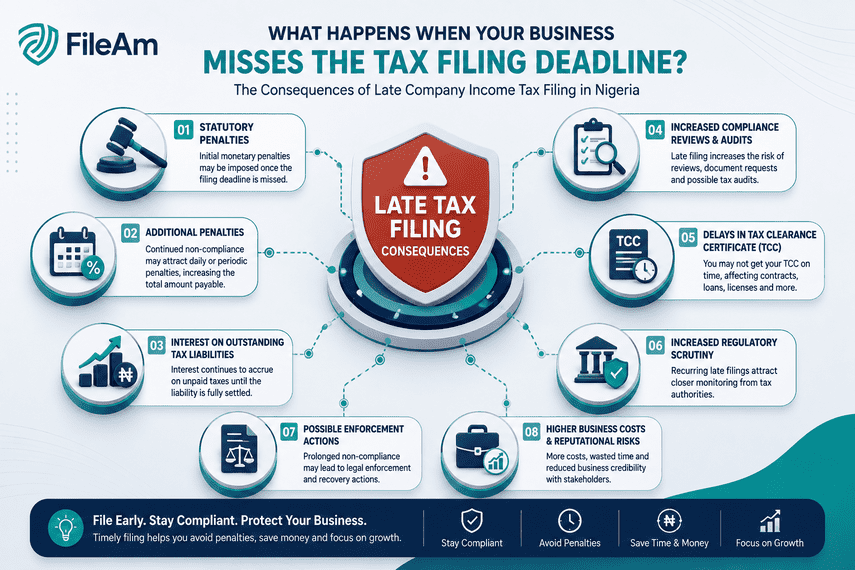
Company Income Tax Late Filing Penalties in Nigeria (2026): What Happens If You File Late?
Filing your Company Income Tax (CIT) return on time is one of the most important tax compliance obligations for every registered company operating in Nigeria. While many business owners prioritize paying taxes, some mistakenly assume that late submission of tax returns carries minimal consequences. In reality, failing to file your Company Income Tax return before the statutory deadline can expose your business to financial penalties, interest on unpaid liabilities, increased regulatory scrutiny, and unnecessary operational disruptions.
As Nigeria’s tax administration continues to embrace digital compliance systems in 2026, tax authorities are better equipped to monitor filing activities, detect defaults, and enforce compliance. Businesses that fail to submit accurate and timely tax returns may not only incur additional costs but may also experience delays in obtaining essential tax documents required for day-to-day business operations.
Whether you are a startup, a growing small or medium-sized enterprise (SME), or a large corporation, understanding the consequences of late filing can help you avoid costly mistakes and build a stronger culture of tax compliance.
Below are the key consequences businesses may face when Company Income Tax returns are filed after the statutory deadline.
1. Statutory Monetary Penalties
The most immediate consequence of late filing is the imposition of statutory monetary penalties in accordance with applicable tax laws.
These penalties are intended to encourage businesses to comply with filing deadlines and to promote voluntary tax compliance. Once the filing deadline has passed, a company may become liable for an initial penalty even if the delay was unintentional.
For many businesses, especially startups and SMEs operating on tight budgets, these penalties represent avoidable expenses that could otherwise be invested in business growth, staff development, or operational improvements.
Submitting your Company Income Tax return before the due date remains the most effective way to avoid these unnecessary costs.
2. Additional Penalties for Continued Non-Compliance
Late filing can become increasingly expensive the longer a business remains in default.
Depending on the applicable legal provisions, businesses that fail to regularize their tax position after the initial deadline may incur additional daily, monthly, or periodic penalties. These incremental charges are designed to discourage prolonged non-compliance and encourage prompt filing.
Many companies underestimate how quickly these additional penalties can accumulate. What begins as a relatively small compliance issue may, over several weeks or months, develop into a significant financial obligation.
This is why tax professionals consistently advise businesses to submit outstanding returns as soon as possible rather than delaying further.
3. Interest on Outstanding Tax Liabilities
Where a company has an outstanding Company Income Tax liability, filing late may also result in interest accruing on the unpaid amount.
Unlike one-off penalties, interest generally continues to accumulate until the outstanding liability has been fully settled. This means that every additional day of delay can increase the total amount payable.
For businesses experiencing cash flow challenges, postponing tax filing and payment may appear convenient in the short term. However, accumulated interest often makes resolving the outstanding liability far more expensive than addressing it promptly.
Maintaining accurate financial records and preparing tax computations early can help businesses estimate their liabilities and make timely payments before interest becomes a significant burden.
4. Increased Compliance Reviews and Possible Tax Audits
Late filing can also increase the likelihood of additional compliance reviews by tax authorities.
Businesses with repeated filing delays or inconsistent tax records may receive requests for supporting documentation, financial statements, accounting records, and tax computations to verify the accuracy of their returns.
Where significant compliance concerns exist, tax authorities may conduct a more detailed review or audit to assess whether the correct amount of tax has been reported and paid.
Although an audit does not automatically indicate wrongdoing, it can require considerable time, resources, and documentation to complete. Companies with strong compliance histories are generally better positioned to respond efficiently to regulatory reviews.
5. Delays in Obtaining a Tax Clearance Certificate (TCC)
A Tax Clearance Certificate (TCC) is one of the most important compliance documents for businesses operating in Nigeria.
Many organizations require a valid TCC when:
- Bidding for government contracts.
- Participating in public procurement exercises.
- Applying for business licences or regulatory approvals.
- Opening or expanding certain business relationships.
- Accessing financing from financial institutions.
- Completing mergers, acquisitions, or other corporate transactions.
Failure to file Company Income Tax returns on time may delay the issuance or renewal of a Tax Clearance Certificate, potentially affecting business opportunities and contractual obligations.
Maintaining timely tax compliance helps ensure that your business can obtain required documentation without unnecessary delays.
6. Increased Regulatory Scrutiny
Companies that repeatedly fail to meet statutory filing deadlines may attract closer attention from tax authorities.
Recurring non-compliance may indicate weaknesses in internal financial controls, accounting processes, or tax management systems. As a result, businesses with poor compliance histories may experience more frequent requests for clarification, additional documentation, or follow-up correspondence.
Consistently meeting filing deadlines demonstrates responsible corporate governance and helps establish your organization as a compliant taxpayer.
7. Higher Administrative and Professional Costs
Many businesses focus only on statutory penalties while overlooking the broader costs associated with late filing.
When compliance issues arise, companies often incur additional expenses, including:
- Professional accounting fees.
- Tax advisory services.
- Legal consultation costs.
- Staff overtime.
- Financial record reconciliation.
- Document retrieval and preparation.
- Administrative costs associated with resolving compliance issues.
These indirect costs can sometimes exceed the statutory penalties themselves, particularly where several years of outstanding filings must be regularized.
Preparing your tax records throughout the financial year and filing before the deadline is generally more cost-effective than correcting compliance issues after they occur.
8. Possible Enforcement Actions
Persistent failure to comply with Company Income Tax filing obligations may expose businesses to lawful enforcement measures available under applicable tax legislation.
Where companies repeatedly ignore filing requirements or fail to respond to compliance notices, tax authorities may initiate recovery procedures or other enforcement actions to encourage compliance.
Although enforcement measures are typically reserved for prolonged or serious non-compliance, businesses should not wait until enforcement becomes necessary. Early compliance remains the safest and most cost-effective approach.
9. Reputational and Commercial Risks
Tax compliance is increasingly regarded as an indicator of sound financial management and responsible corporate governance.
Investors, lenders, suppliers, business partners, and procurement agencies often consider a company’s compliance history when evaluating commercial relationships.
Repeated late filing may negatively affect stakeholder confidence and could influence future investment opportunities, financing arrangements, partnership discussions, or eligibility for certain business opportunities.
Maintaining a strong compliance record demonstrates professionalism, transparency, and effective financial management.
10. Increased Overall Cost of Non-Compliance
One of the biggest misconceptions among business owners is that delaying tax filing saves money.
In reality, the opposite is often true.
A missed filing deadline can trigger a chain of avoidable expenses, including statutory penalties, accumulated interest, professional service fees, administrative costs, and time spent resolving compliance issues. These costs may also be accompanied by delays in obtaining critical compliance documents and increased regulatory engagement.
The longer a business postpones filing, the greater the financial and operational consequences are likely to become.
For this reason, businesses should establish a proactive tax compliance strategy that includes maintaining accurate accounting records, preparing financial statements promptly, monitoring statutory deadlines, and using reliable digital tax filing solutions to simplify the filing process.
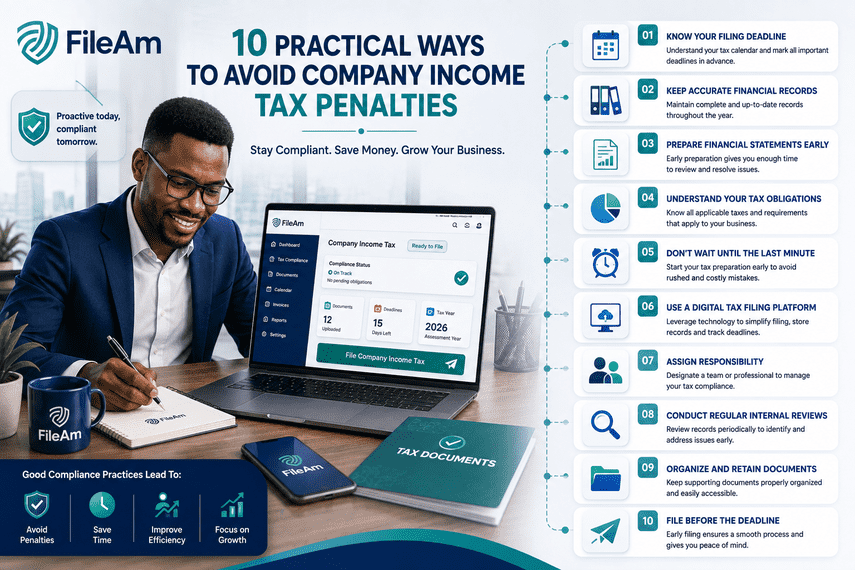
How to Avoid Company Income Tax Late Filing Penalties in Nigeria
Avoiding Company Income Tax late filing penalties in Nigeria is far easier—and significantly less expensive—than resolving compliance issues after the filing deadline has passed. While tax obligations may seem complex, businesses that adopt proactive tax management practices can reduce the risk of penalties, interest charges, and unnecessary regulatory complications.
Whether you are managing a newly incorporated business or an established company, implementing the right compliance strategies can help you stay ahead of statutory deadlines and maintain a strong tax compliance record.
Below are practical steps every business should take to avoid late filing penalties.
1. Know Your Company Income Tax Filing Deadline
One of the most common reasons businesses incur penalties is simply because they are unaware of their filing deadline.
Under Nigeria’s tax laws, the filing deadline is generally determined by your company’s financial year-end. For most companies, Company Income Tax returns must be submitted within the period prescribed by law after the end of the accounting year.
Business owners should avoid relying on memory alone. Instead, maintain a documented compliance calendar that captures all important tax deadlines, including Company Income Tax, Value Added Tax (VAT), Withholding Tax (WHT), PAYE, and Annual Returns.
Knowing your filing deadline is the first step toward avoiding unnecessary penalties.
2. Maintain Accurate Financial Records Throughout the Year
Preparing Company Income Tax returns becomes much easier when financial records are accurate and up to date.
Many businesses delay filing because accounting records are incomplete or require extensive reconciliation shortly before the deadline. This often results in rushed tax computations, missing documents, and avoidable errors.
To simplify the filing process, businesses should maintain:
- Proper bookkeeping records.
- Updated sales and expense records.
- Bank reconciliation statements.
- Payroll records.
- Fixed asset registers.
- Inventory records where applicable.
- Supporting invoices and receipts.
- Previous tax returns and compliance documents.
Keeping financial information organized throughout the year significantly reduces the workload during tax season.
3. Prepare Financial Statements Early
Preparing annual financial statements at the last minute is one of the leading causes of late Company Income Tax filing.
Financial statements form the foundation of Company Income Tax computations. Delays in completing these reports often postpone the entire filing process.
Rather than waiting until the filing deadline approaches, businesses should begin preparing financial statements immediately after the end of their accounting year.
Early preparation provides sufficient time to:
- Review accounting records.
- Correct reporting errors.
- Resolve discrepancies.
- Complete tax computations accurately.
- Gather supporting documentation.
This proactive approach minimizes last-minute pressure and improves filing accuracy.
4. Understand Your Company’s Tax Obligations
Every business has unique tax responsibilities depending on its size, industry, and operational structure.
Apart from Company Income Tax, many businesses are also required to comply with obligations relating to:
- Value Added Tax (VAT).
- Withholding Tax (WHT).
- Pay As You Earn (PAYE).
- Tertiary Education Tax where applicable.
- Capital Gains Tax in qualifying transactions.
- Annual Returns and other statutory filings.
Understanding how these obligations interact helps businesses develop a comprehensive compliance strategy and avoid overlapping filing challenges.
Where uncertainty exists, seeking professional tax advice before deadlines can prevent costly mistakes
5. Avoid Waiting Until the Last Minute
Many businesses only begin preparing their tax returns a few days before the filing deadline.
This approach increases the likelihood of:
- Missing documentation.
- Calculation errors.
- Technical filing issues.
- Delayed approvals.
- Incomplete submissions.
Unexpected events such as internet connectivity problems, system maintenance, staff absences, or outstanding accounting adjustments can also delay filing.
Starting the preparation process several weeks before the due date provides sufficient time to resolve issues without risking non-compliance.
6. Use a Digital Tax Filing Platform
Modern businesses are increasingly replacing manual filing processes with digital tax compliance solutions.
Using an online tax filing platform helps businesses simplify compliance by reducing paperwork, improving accuracy, and keeping important tax information organized in one secure location.
A digital tax filing solution can help businesses:
- Monitor statutory deadlines.
- Organize compliance documents.
- Reduce manual errors.
- Improve filing efficiency.
- Store tax records securely.
- Simplify collaboration with accountants and finance teams.
As tax administration becomes increasingly digital, adopting technology-driven compliance tools can significantly improve tax management.
7. Assign Responsibility for Tax Compliance
Tax compliance should never be left to chance.
Every organization should clearly assign responsibility for monitoring filing deadlines, preparing documentation, and coordinating tax submissions.
Depending on the size of the business, this responsibility may rest with:
- The business owner.
- An internal finance officer.
- The accounting department.
- An external accountant.
- A licensed tax consultant.
Clearly defined responsibilities reduce the risk of deadlines being overlooked.
8. Conduct Regular Internal Compliance Reviews
Rather than reviewing tax obligations only once a year, businesses should periodically assess their compliance status.
Quarterly or semi-annual reviews allow organizations to identify potential issues early, including:
- Missing accounting records.
- Outstanding tax liabilities.
- Documentation gaps.
- Incomplete reconciliations.
- Filing errors requiring correction.
Regular reviews reduce last-minute surprises and strengthen overall financial management.
9. Keep Supporting Documents Properly Organized
Incomplete documentation is another major cause of delayed tax filing.
Businesses should maintain an organized record of documents that may be required during tax preparation or compliance reviews, including:
- Audited financial statements.
- Trial balances.
- General ledgers.
- Bank statements.
- Expense receipts.
- Sales invoices.
- Payroll schedules.
- Tax payment receipts.
- Previous Company Income Tax returns.
Having these documents readily available significantly accelerates the filing process.
10. File Before the Deadline, Not On the Deadline
One of the best practices for tax compliance is to submit Company Income Tax returns several days or weeks before the statutory deadline.
Early filing provides additional time to resolve unexpected issues, make corrections if necessary, and ensure all supporting documentation has been properly submitted.
Businesses that consistently file early experience fewer compliance challenges and reduce the likelihood of incurring avoidable penalties.
Why More Nigerian Businesses Are Choosing Digital Tax Filing
Tax compliance is no longer just about meeting legal obligations; it is about improving operational efficiency and reducing compliance risks.
Traditional manual filing processes often involve paperwork, multiple spreadsheets, scattered financial records, and lengthy administrative procedures. These methods increase the likelihood of missed deadlines and filing errors.
Digital tax filing platforms provide a faster, more organized, and more reliable approach to compliance by enabling businesses to manage tax obligations from a centralized platform.
Solutions like FileAm help businesses streamline Company Income Tax filing by organizing compliance records, simplifying document management, tracking filing obligations, and reducing the administrative burden associated with annual tax returns.
As Nigeria’s tax system continues to embrace digital transformation, businesses that adopt technology-driven compliance solutions are better positioned to remain compliant, avoid penalties, and focus on sustainable growth.
How to File Company Income Tax in Nigeria (2026): A Step-by-Step Guide
Filing Company Income Tax (CIT) in Nigeria is a statutory obligation for every eligible company. Although the filing process may appear technical, it becomes much more manageable when businesses prepare the required documents in advance and follow a structured approach.
Whether you are filing for the first time or preparing your annual tax return, understanding each stage of the process can help you reduce errors, avoid delays, and remain compliant with Nigeria’s tax regulations.
Below is a step-by-step overview of the Company Income Tax filing process.
Step 1: Determine Your Filing Deadline
Before preparing your tax return, confirm your company’s filing deadline based on your financial year-end.
Missing this deadline may expose your business to penalties, interest on unpaid tax liabilities, and other compliance challenges. Businesses should maintain a compliance calendar and begin preparing their returns well before the due date.
Starting early provides sufficient time to gather documentation, review financial records, and resolve any discrepancies before submission.
Step 2: Prepare Your Financial Statements
Accurate financial statements form the foundation of every Company Income Tax return.
Before filing, ensure your business has prepared complete financial statements for the relevant accounting period. Depending on your business, these may include:
- Statement of Financial Position (Balance Sheet)
- Statement of Profit or Loss
- Statement of Cash Flows
- Statement of Changes in Equity
- Notes to the Financial Statements
- Trial Balance
- General Ledger
Businesses that maintain accurate bookkeeping throughout the year typically complete this stage much faster and with fewer errors.
Step 3: Calculate Your Taxable Profit
Company Income Tax is generally assessed based on a company’s taxable profit rather than its total revenue.
This stage involves adjusting accounting profits in accordance with applicable tax laws by identifying allowable deductions, non-deductible expenses, capital allowances, and other relevant tax adjustments.
Because tax computations can be complex, many businesses engage qualified accountants or tax professionals to ensure accuracy and compliance.
Incorrect tax computations may result in underpayment, overpayment, or future compliance reviews.
Step 4: Gather Supporting Documents
Before submitting your tax return, ensure all supporting documentation is complete and readily available.
Common documents required during the filing process may include:
- Audited financial statements (where applicable)
- Tax computation schedules
- Capital allowance computations
- Evidence of tax payments
- Bank statements where required
- Previous tax returns
- Corporate registration documents
- Other supporting schedules requested by the relevant tax authority
Keeping these documents organized throughout the year significantly reduces the time required to complete your annual filing.
Step 5: Complete Your Company Income Tax Return
Once your financial information has been verified, complete the Company Income Tax return accurately.
Before submission, review the return carefully to ensure:
- Company information is correct.
- Financial figures are consistent with supporting records.
- Tax computations are accurate.
- Required schedules have been completed.
- Supporting documents have been attached where necessary.
Even small errors can delay processing or result in requests for additional clarification.
Step 6: Submit Your Company Income Tax Return Before the Deadline
Submitting your return before the statutory deadline is one of the most effective ways to avoid late filing penalties.
Businesses should avoid waiting until the final day, as unexpected technical issues, incomplete documentation, or last-minute corrections may delay submission.
Filing early provides peace of mind and allows sufficient time to resolve any issues that may arise.
Step 7: Pay Any Outstanding Tax Liability
Where Company Income Tax is payable, ensure payment is made within the applicable timeline.
Delays in settling outstanding tax liabilities may result in additional interest charges and increase the overall cost of compliance.
Maintaining adequate financial planning throughout the year can help businesses meet their tax obligations without placing unnecessary pressure on cash flow.
Step 8: Retain Your Tax Records
Submitting your Company Income Tax return is not the final step.
Businesses should securely retain copies of:
- Filed tax returns
- Financial statements
- Tax computations
- Payment receipts
- Supporting schedules
- Correspondence relating to tax filings
Maintaining proper records makes future filings easier and helps businesses respond efficiently to compliance reviews or audit requests.
Common Mistakes Businesses Make When Filing Company Income Tax
Many late filings and compliance issues result from avoidable mistakes rather than deliberate non-compliance.
Some of the most common errors include:
- Waiting until the filing deadline before starting preparations.
- Maintaining incomplete accounting records.
- Using incorrect financial information.
- Omitting required supporting documents.
- Failing to reconcile accounting records before filing.
- Miscalculating taxable profits.
- Forgetting to retain copies of submitted returns.
- Missing important statutory deadlines.
- Relying entirely on manual filing processes.
- Ignoring professional tax advice where necessary.
Avoiding these mistakes can save businesses significant time, money, and administrative effort.
Why Businesses Are Moving Away from Manual Tax Filing
Traditional tax filing methods often involve multiple spreadsheets, paper documents, manual calculations, and lengthy administrative processes.
As businesses grow, these manual systems become increasingly difficult to manage and can contribute to missed deadlines, filing errors, and compliance risks.
Digital tax filing platforms offer a more efficient alternative by helping businesses centralize compliance activities, organize financial records, monitor filing deadlines, and simplify collaboration with finance teams and tax professionals.
By replacing manual processes with digital workflows, businesses can improve accuracy, reduce administrative workload, and strengthen their overall compliance posture.
Simplify Company Income Tax Filing with FileAm
Tax compliance does not have to be complicated.
FileAm is designed to simplify the Company Income Tax filing process by helping businesses manage tax obligations through an intuitive digital platform.
With FileAm, businesses can:
- Prepare for annual tax filing with greater confidence.
- Organize financial and compliance documents in one secure location.
- Keep track of important tax deadlines.
- Reduce paperwork and manual administrative tasks.
- Improve collaboration between business owners, accountants, and finance teams.
- Support timely and accurate tax filing.
Whether you are filing for the first time or managing tax compliance for an established organization, FileAm provides a smarter and more efficient way to stay compliant while reducing the risk of late filing penalties.
By embracing digital tax management, businesses can spend less time on administrative processes and more time focusing on growth, profitability, and long-term success.
Why Businesses Choose FileAm for Company Income Tax Filing in Nigeria

As tax compliance requirements continue to evolve, many businesses are moving away from manual filing processes in favor of digital solutions that improve efficiency, accuracy, and compliance. Whether you are a startup, a growing SME, or a large enterprise, managing Company Income Tax obligations manually can become time-consuming and increase the risk of costly mistakes.
FileAm is a modern digital tax compliance platform designed to simplify the way Nigerian businesses prepare, manage, and file their statutory tax obligations. By combining intuitive technology with a user-friendly interface, FileAm helps businesses stay organized, reduce administrative workload, and meet important filing deadlines with greater confidence.
A Smarter Way to Manage Tax Compliance
Traditional tax filing often involves multiple spreadsheets, paper records, email exchanges, and manual calculations. These fragmented processes can lead to misplaced documents, duplicated work, and missed deadlines.
FileAm centralizes your tax compliance activities in one secure platform, making it easier to manage records, monitor filing obligations, and prepare for annual Company Income Tax filing.
Reduce the Risk of Late Filing
Late filing is one of the most common compliance challenges facing businesses in Nigeria. By helping businesses stay organized and aware of important filing timelines, FileAm supports proactive tax management and reduces the likelihood of avoidable penalties.
Rather than rushing to prepare tax returns at the last minute, businesses can maintain an organized compliance process throughout the year.
Improve Accuracy and Organization
Accurate tax filing begins with accurate records.
FileAm enables businesses to organize important compliance documents, maintain structured tax records, and simplify collaboration between business owners, accountants, auditors, and finance teams.
Better organization not only improves filing efficiency but also makes responding to compliance reviews or audit requests significantly easier.
Save Time and Administrative Costs
Manual tax administration consumes valuable business resources.
From searching for financial documents to reconciling records and preparing submissions, traditional filing methods often require significant staff time and professional support.
By streamlining compliance processes, FileAm helps businesses reduce administrative overhead, allowing teams to focus on strategic business activities rather than repetitive manual tasks.
Built for Nigerian Businesses
FileAm is designed with the needs of Nigerian businesses in mind. Whether you operate a small business, a medium-sized enterprise, or a large organization, the platform supports efficient tax compliance while adapting to the realities of Nigeria’s evolving regulatory environment.
Instead of treating tax compliance as a once-a-year exercise, businesses can build a continuous compliance culture that supports sustainable growth and stronger financial governance
Before submitting your Company Income Tax return, use the checklist below to ensure your business is fully prepared.
✔ Confirm your Company Income Tax filing deadline.
✔ Finalize your financial statements.
✔ Complete your tax computations accurately.
✔ Review your accounting records for errors or omissions.
✔ Gather all supporting documents.
✔ Verify company information and registration details.
✔ Confirm any outstanding tax liabilities.
✔ Submit your Company Income Tax return before the statutory deadline.
✔ Retain copies of your submitted return and supporting documents.
✔ Monitor future compliance obligations using a structured compliance calendar or digital tax filing platform.
Completing these simple checks can significantly reduce the likelihood of filing errors, unnecessary delays, and avoidable penalties.
Frequently Asked Questions (FAQs)
What is Company Income Tax in Nigeria?
Company Income Tax (CIT) is a tax imposed on the taxable profits of eligible companies operating in Nigeria. Companies are generally required to calculate their taxable profits, prepare annual tax returns, and submit them within the statutory filing period.
What happens if I file Company Income Tax late in Nigeria?
Late filing may expose a business to statutory penalties, interest on outstanding tax liabilities where applicable, increased compliance reviews, delays in obtaining Tax Clearance Certificates, and other enforcement measures provided under relevant tax laws.
How can I avoid Company Income Tax late filing penalties?
Businesses can avoid penalties by maintaining accurate accounting records, preparing financial statements early, monitoring statutory deadlines, organizing supporting documentation, and submitting tax returns before the filing deadline.
When should Company Income Tax be filed?
The filing deadline generally depends on the company’s financial year-end and the applicable provisions of Nigerian tax law. Businesses should confirm their statutory deadline based on their accounting period and ensure adequate preparation well in advance.
Can small businesses file Company Income Tax online?
Yes. Many businesses now use digital tax filing platforms and online compliance solutions to simplify the preparation and submission of Company Income Tax returns while improving record management and filing efficiency.
Why should businesses use a digital tax filing platform?
Digital tax filing platforms help businesses reduce manual paperwork, improve organization, monitor filing deadlines, simplify document management, and support more efficient tax compliance processes.
How does FileAm help businesses stay compliant?
FileAm helps businesses organize compliance records, simplify tax preparation, monitor important filing obligations, reduce administrative workload, and support timely Company Income Tax filing through a secure digital platform.
Conclusion
Timely Company Income Tax filing is more than a statutory requirement; it is a critical component of responsible financial management and good corporate governance. Businesses that consistently meet their filing obligations are better positioned to avoid penalties, maintain positive compliance records, secure Tax Clearance Certificates when needed, and build trust with regulators, investors, lenders, and business partners.
On the other hand, delaying tax compliance can result in avoidable financial costs, operational disruptions, and increased regulatory attention. As Nigeria’s tax administration continues to embrace digital transformation, businesses that rely solely on manual processes may find it increasingly difficult to keep pace with evolving compliance requirements.
Adopting a proactive approach to tax management, through accurate record-keeping, early preparation, and the use of digital compliance tools, can significantly reduce compliance risks and improve operational efficiency.
If you’re looking for a simpler way to manage your Company’s Income Tax obligations, FileAm provides a modern, secure, and efficient platform that helps businesses stay organized, meet filing deadlines, and reduce the risk of costly late filing penalties.
Start preparing early, stay compliant, and let technology make tax filing easier for your business.
Key Takeaways
- Company Income Tax returns should always be filed before the statutory deadline.
- Late filing can lead to penalties, interest, administrative costs, and compliance challenges.
- Maintaining accurate financial records throughout the year simplifies tax filing.
- Early preparation reduces the risk of last-minute errors and missed deadlines.
- Digital tax filing solutions improve efficiency, organization, and compliance.
- FileAm helps Nigerian businesses streamline Company Income Tax compliance through a secure, user-friendly platform.
Leave a Reply